6 min read
Limb Lengthening Surgery: Who Needs It and What the Process Involves
Limb lengthening is a highly specialised, gradual surgical process, not a quick fix. Here's who it's actually appropriate for and what the process genuinely involves.
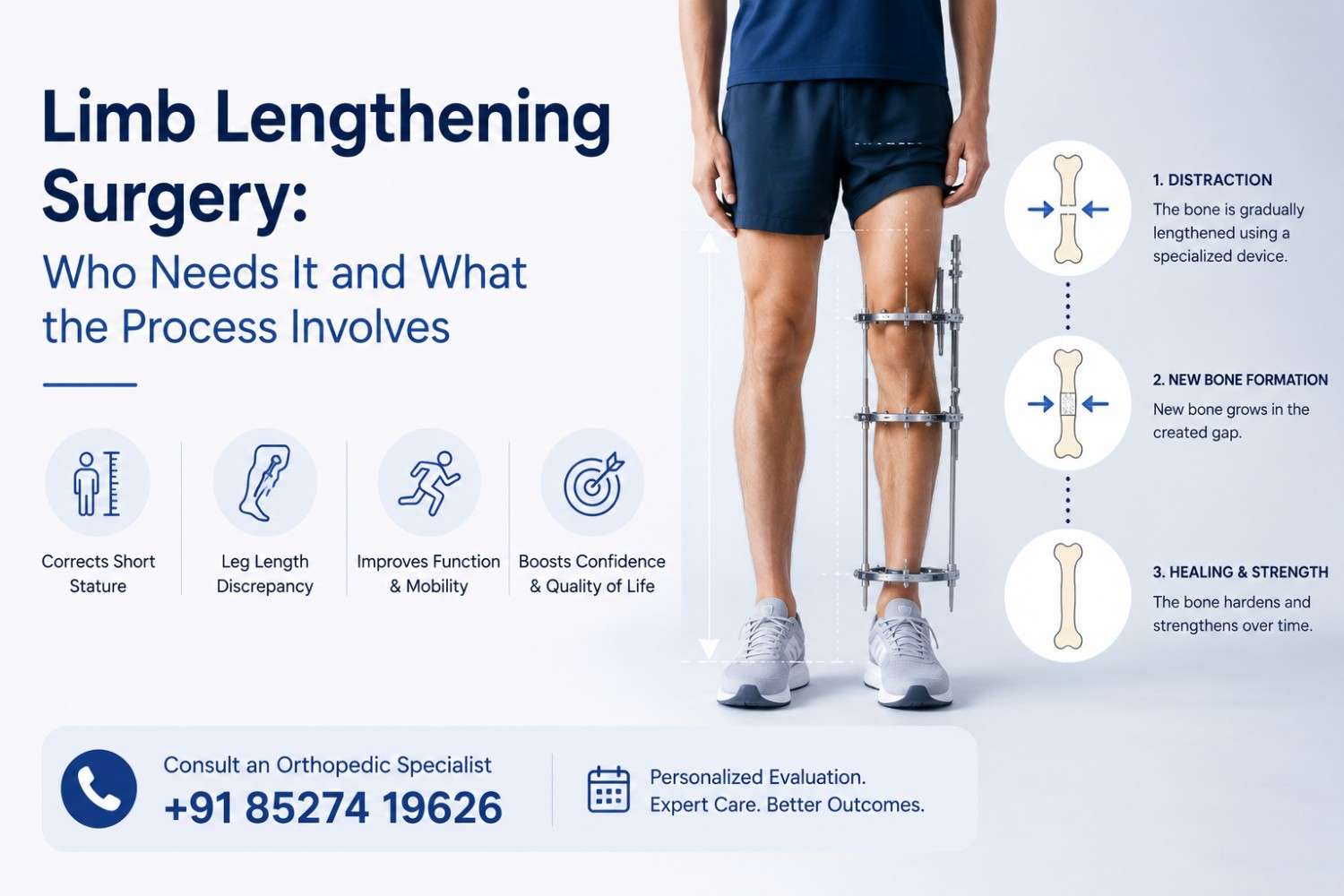
Limb Lengthening Surgery: Who Needs It and What the Process Involves
Limb lengthening surgery is one of the more specialised and, understandably, less widely understood areas of orthopedic surgery. It's a gradual, carefully staged process rather than a single operation with an immediate result, and it's appropriate for a specific range of medical situations, congenital limb length discrepancy, growth abnormalities, or the after-effects of certain injuries or infections, as well as, in select appropriately screened cases, cosmetic height increase.
Who Is a Candidate
Congenital Limb Length Discrepancy
Some individuals are born with one limb shorter than the other, due to a range of underlying developmental conditions, which can affect gait, posture, and over time, contribute to back and joint problems if left unaddressed.
Growth Plate Injuries Affecting Bone Length
As covered in our related article on sports injuries in young athletes, growth plate injuries can occasionally affect a bone's subsequent growth, sometimes resulting in a length discrepancy that becomes apparent over subsequent years of development.
Post-Infection or Post-Trauma Bone Loss
Severe fractures or bone infections can, in some cases, result in bone loss or growth disruption significant enough to create a meaningful length discrepancy requiring correction.
Certain Skeletal Conditions
Various congenital and developmental skeletal conditions can result in disproportionate limb length, where lengthening surgery is part of a broader treatment approach.
Cosmetic Height Increase
For carefully selected adult patients, limb lengthening for height increase is a recognised, though highly demanding, procedure requiring thorough evaluation, realistic expectation-setting, and full understanding of the significant time and physical commitment involved.
How the Process Actually Works
The Surgical Procedure
The bone is surgically cut (a controlled osteotomy) and a lengthening device, either an external fixator or increasingly, a more comfortable internal lengthening nail, is fitted to gradually separate the two bone segments over time.
The Distraction Phase
Over the following weeks, the device is adjusted incrementally, typically around one millimetre per day, divided into several smaller adjustments, gradually separating the bone segments. The body responds by forming new bone in the widening gap, a biological process called distraction osteogenesis.
The Consolidation Phase
Once the target length is reached, the newly formed bone needs time, often several months, to fully harden and strengthen (consolidate) before the lengthening device is removed and full weight-bearing activity resumes without restriction.
Physiotherapy Throughout
Structured physiotherapy runs throughout the entire process, maintaining joint range of motion and muscle strength as the surrounding soft tissue gradually adapts to the increasing bone length, which is itself a significant part of what the body needs to accommodate.
What the Process Actually Requires
This is a genuinely significant commitment: the total process, from surgery through full consolidation, commonly spans many months to over a year depending on the amount of lengthening required, with regular follow-up visits, and for external fixator methods, ongoing pin site care to prevent infection. Patients considering this procedure, for any indication, need a realistic understanding of this timeline and commitment, not an expectation of a quick, straightforward fix.
Getting a Proper Evaluation
Given the complexity and commitment involved, a thorough evaluation, including detailed imaging to precisely measure any discrepancy and assess overall limb alignment, alongside a candid conversation about goals, risks, and the realistic timeline, is essential before proceeding. Our limb reconstruction and lengthening practice takes this evaluation seriously, ensuring patients enter the process with accurate expectations rather than an oversimplified picture of what's involved.
Managing Expectations About the Experience
Patients considering limb lengthening, for any indication, benefit from speaking candidly with their surgical team about the day-to-day reality of the process, not just the eventual outcome. There will be a period of visible hardware, whether external or the incision needed for an internal nail, adjustments to daily routines, work, and in some cases travel, and a genuine physical and psychological adjustment during the months of the process itself. Patients who go in with an accurate, detailed picture of this experience, rather than focusing only on the end result, generally navigate the process with considerably less frustration than those who underestimate what the months in between actually involve.
Life After Consolidation
Once the lengthening device is removed and the newly formed bone has fully consolidated, most patients return to normal or near-normal activity levels, including sports and exercise, following a period of gradual reconditioning. The new bone, once fully matured, functions like any other bone in the body, and long-term outcomes for appropriately selected, well-managed patients are generally very good, a genuinely encouraging endpoint after what is undeniably a demanding process to get there.
Frequently Asked Questions (FAQs)
1. Are there age limits for limb lengthening surgery?
Candidacy depends more on skeletal maturity and overall health than a strict age cutoff, and is assessed individually for each patient during evaluation.
2. Can school or work continue during the lengthening process?
With some adjustment, many patients continue school or remote work during the process, though the physical demands and appointment frequency should be discussed and planned for in advance.
3. Is a second opinion recommended before committing to limb lengthening surgery?
Given the significant commitment involved, seeking a second opinion is a reasonable and often encouraged step before proceeding with this particular type of surgery.
4. Can limb lengthening be performed on more than one bone at a time?
In select complex cases yes, though this significantly increases the complexity and demands of the process, and is planned carefully based on the individual's specific situation.
5. Is limb lengthening surgery available for adults, or only growing children?
It's performed in both populations, though the underlying indication and specific technique may differ between a growing child and a skeletally mature adult.
6. How much can a limb typically be lengthened in one procedure?
This varies by individual factors including bone quality and soft tissue tolerance, and is determined through careful evaluation rather than a fixed universal number, with the surgeon setting a realistic, safe target.
7. Is limb lengthening surgery painful?
There is discomfort, particularly during the distraction phase, though this is generally manageable with appropriate pain management, and most patients find it more tolerable than initially anticipated with proper support.
8. How long does the entire limb lengthening process take?
The total process, including distraction and consolidation, commonly spans several months to over a year depending on how much lengthening is needed, which should be discussed in detail during evaluation.
9. Are internal lengthening nails better than external fixators?
Internal nails generally offer more comfort and lower infection risk since there's no external hardware, though the appropriate device depends on individual factors your surgeon will assess.
10. Is limb lengthening for height increase safe?
It can be performed safely in carefully selected, thoroughly evaluated patients, but it carries real risks and demands significant commitment, which is why thorough screening and realistic expectation-setting matter enormously.
11. Can physiotherapy be done at home during the lengthening process?
Much of it can, with guidance, though regular in-person follow-up with the surgical and physiotherapy team remains important throughout the process to monitor progress and adjust the plan.
This article is for educational purposes and does not replace personalized medical advice. Please consult a qualified physician before making changes to your treatment, medication, or health screening plan.
Related Articles
X-Ray में Knee Joint Space कम लिखा है तो क्या मतलब है? क्या Knee Replacement जरूरी है?
Knee X-ray में joint space कम होने का अर्थ, osteoarthritis की grading, symptoms से संबंध और knee replacement कब जरूरी हो सकती है, आसान हिंदी में समझें।
Revision Knee Replacement: Why Knee Implants Fail and When Revision Surgery Is Needed
Learn why knee implants can fail, the warning signs of loosening or infection, and when revision knee replacement may be necessary.
Ankle Sprain Recovery Timeline: Walking to Sport
A practical ankle sprain recovery timeline covering early care, safe walking, exercises, return to running, and signs that may indicate a fracture.