7 min read
Partial vs Total Knee Replacement: Who Is a Good Candidate?
Understand how partial and total knee replacement differ, which findings affect candidacy, and why the final decision requires symptoms, examination and imaging together.
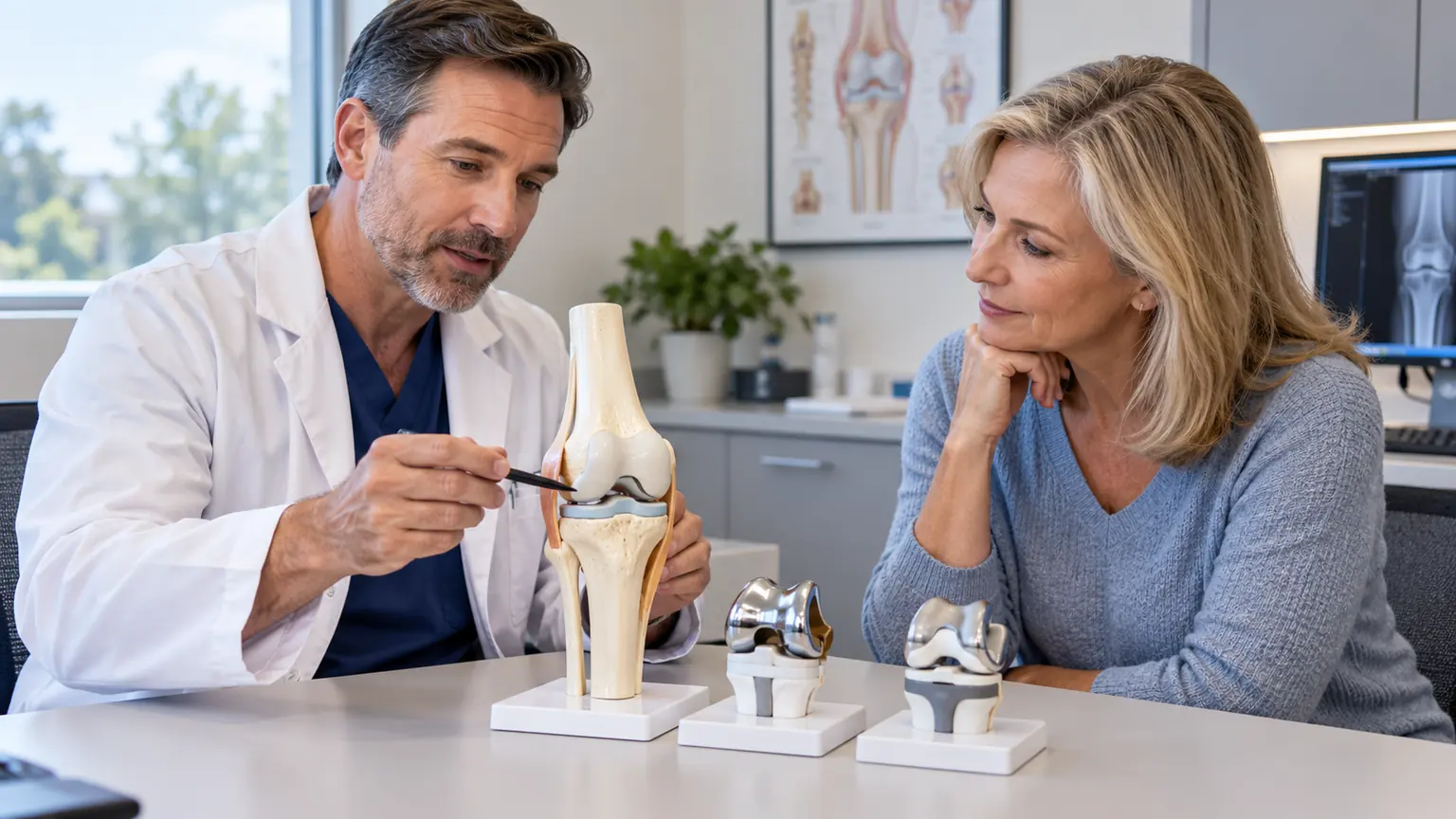
Partial vs Total Knee Replacement: Who Is a Good Candidate?
Patients with advanced knee arthritis often ask whether a partial knee replacement can preserve more of the natural joint than a total knee replacement. The answer cannot be based on age or one X-ray line alone. Partial replacement works best when damage is truly limited to one compartment, the ligaments are functional, movement is acceptable, and symptoms match the affected area. Total knee replacement is usually considered when arthritis is more widespread or when deformity, stiffness, or instability makes a partial procedure unsuitable.
Both operations can reduce pain and improve function in appropriately selected patients, but neither procedure guarantees a particular result. A surgeon must combine your history, examination, weight-bearing X-rays, medical fitness, activity goals, and response to nonsurgical care. This article explains the decision in patient-friendly terms and is not a substitute for an orthopedic consultation.
How the knee is divided into compartments
The knee is commonly described as having three compartments. The medial compartment lies on the inner side, the lateral compartment on the outer side, and the patellofemoral compartment sits between the kneecap and the front of the thigh bone. Osteoarthritis may be concentrated in one area or may involve two or all three.
A unicompartmental or partial knee replacement resurfaces only the damaged compartment. A total knee replacement resurfaces the ends of the thigh bone and shin bone across the joint, and the surgeon may also address the kneecap surface depending on the case. “Total” does not mean the entire knee is removed. The operation replaces damaged joint surfaces while preserving important surrounding structures.
What makes someone a possible partial knee replacement candidate?
According to patient guidance from the American Academy of Orthopaedic Surgeons, arthritis should be limited to one compartment for a standard unicompartmental replacement. The pain pattern, examination, and imaging should agree. Common factors considered include:
- Pain located mainly on the inner or outer side of the knee rather than throughout the joint.
- Advanced cartilage loss confined to a single compartment on appropriate X-rays.
- Functional knee ligaments, particularly those needed for stability.
- A range of motion that is not severely restricted.
- A deformity that is limited and can be corrected appropriately.
- Symptoms that remain significant despite a reasonable trial of nonsurgical treatment.
- Medical fitness for surgery and realistic expectations about rehabilitation.
Age alone is not a strict yes-or-no rule. Activity level, anatomy, bone quality, disease pattern, body weight, and long-term priorities all contribute. Modern partial implants can perform well in both younger and older adults when selection and surgical technique are appropriate.
When total knee replacement may be more appropriate
Total knee replacement may be considered when pain and cartilage loss affect more than one compartment, when the knee is markedly stiff, or when deformity and ligament damage reduce stability. Inflammatory arthritis can involve the joint more diffusely and may make a partial replacement unsuitable. A previous ligament injury, significant kneecap disease, or bone loss may also change the plan.
Patients sometimes focus on choosing the “smaller” operation. The better question is which operation matches the actual disease. A partial replacement performed in a knee with unrecognized disease elsewhere may leave pain behind or require later conversion. A total replacement in a genuinely isolated pattern may replace more surface than necessary. Good decision-making aims to avoid both problems.
How partial and total replacement differ
Amount of joint resurfaced
Partial replacement treats one compartment and preserves more native bone and joint surfaces. Total replacement addresses disease across the joint. The extent of surgery affects recovery, but it is only one part of outcome.
Incision and early recovery
Partial replacement is often performed through a smaller approach and may allow a quicker early recovery in selected patients. Hospital stay and walking progression vary by anaesthesia, medical health, pain control, home support, and local protocols. It is not responsible to promise a fixed recovery date.
Feeling and movement
Because more native structures are retained, some patients report a more natural-feeling knee after partial replacement. Individual experiences differ. Rehabilitation, alignment, implant position, strength, and expectations influence function after either procedure.
Future surgery
Arthritis can progress in the unreplaced compartments after a partial replacement, and some patients later need conversion to total knee replacement. Total knee implants can also wear, loosen, become infected, or require revision for other reasons. Learn more in our guide to why knee implants fail and when revision is considered.
What tests help decide?
Weight-bearing X-rays show where joint-space loss, bone spurs, sclerosis, and deformity are located. Special views may help evaluate the kneecap or confirm whether another compartment retains cartilage. An MRI is not automatically required for every arthritic knee, although it may be useful in selected situations.
The physical examination assesses tenderness, alignment, range of motion, ligament stability, hip movement, walking, and sometimes the spine. Symptoms and imaging must be matched. A narrow joint space on an X-ray does not by itself make replacement necessary. Our Hindi explainer on knee joint-space narrowing on X-ray discusses this in more detail.
What should be tried before replacement?
When clinically appropriate, nonsurgical management may include activity modification, strength and mobility work, weight management, walking aids, selected pain medicines, and injections. Treatment depends on medical history and should be individualized. Surgery is usually considered when pain, stiffness, and loss of function remain substantial despite reasonable conservative care, not simply because an X-ray looks advanced.
However, delaying indefinitely is not always helpful if daily function is severely restricted and appropriate nonsurgical options have been exhausted. Shared decision-making should consider sleep, walking distance, work, stairs, caregiving duties, medical risk, and the patient's priorities.
Questions to discuss with the orthopedic surgeon
- Which compartments of my knee are affected on weight-bearing X-rays?
- Are my cruciate and collateral ligaments functioning adequately?
- Is my deformity correctable, and how much stiffness is present?
- What nonsurgical options remain reasonable for me?
- Why do you recommend partial or total replacement for this specific pattern?
- What could change the plan during surgery?
- What are the risks of infection, stiffness, clots, persistent pain, and revision in my situation?
- What will rehabilitation involve, and what support will I need at home?
An ethical consultation should explain benefits, alternatives, limitations, and material risks without guaranteeing an outcome or using fear to push a decision.
Recovery principles after either operation
Most programs encourage early safe movement, swelling control, knee extension, gradual bending, and progressive strengthening. The exact plan depends on the procedure and the surgeon's instructions. Wound care, clot prevention, medication use, and follow-up are as important as exercise.
Contact the treating team urgently for worsening wound drainage, increasing redness, fever, new calf swelling, chest pain, breathlessness, sudden inability to bear weight, or rapidly increasing pain. Do not copy another patient's exercise schedule or stop prescribed medicines based on a blog.
Frequently asked questions
Is partial knee replacement always better because it is smaller?
No. It is better only when the arthritis pattern, ligaments, movement, and anatomy make it appropriate. Poor selection can lead to persistent symptoms or further surgery.
Can partial knee replacement be converted to total replacement later?
Yes, conversion is possible when arthritis progresses or the implant fails, but it is still revision surgery and may be more complex than a first operation.
Is there an age limit for partial knee replacement?
There is no single universal age cut-off. Disease location, ligament function, activity, bone quality, health, and expectations matter more than age alone.
Do I need surgery if only one compartment is damaged?
Not automatically. Symptom severity, function, examination, and response to nonsurgical treatment must also support the decision.
Does total knee replacement remove the whole knee?
No. It resurfaces damaged joint ends with implant components while preserving surrounding muscles and tendons and selected ligaments according to technique.
Can a surgeon know the final plan before surgery?
Usually the plan is based on examination and imaging, but direct inspection can occasionally reveal disease that changes the safest option. Any backup plan should be discussed during consent.
Medical note: This article is for general education. It does not establish candidacy for surgery. An orthopedic surgeon must evaluate the individual patient and obtain informed consent before treatment.
Related Articles
X-Ray में Knee Joint Space कम लिखा है तो क्या मतलब है? क्या Knee Replacement जरूरी है?
Knee X-ray में joint space कम होने का अर्थ, osteoarthritis की grading, symptoms से संबंध और knee replacement कब जरूरी हो सकती है, आसान हिंदी में समझें।
Revision Knee Replacement: Why Knee Implants Fail and When Revision Surgery Is Needed
Learn why knee implants can fail, the warning signs of loosening or infection, and when revision knee replacement may be necessary.
Ankle Sprain Recovery Timeline: Walking to Sport
A practical ankle sprain recovery timeline covering early care, safe walking, exercises, return to running, and signs that may indicate a fracture.