6 min read
Arthroscopic Knee Surgery: What It Treats and How It Differs From Open Surgery
Arthroscopic knee surgery has transformed recovery for many knee conditions. Here's what it actually involves and why it differs so much from traditional open surgery.
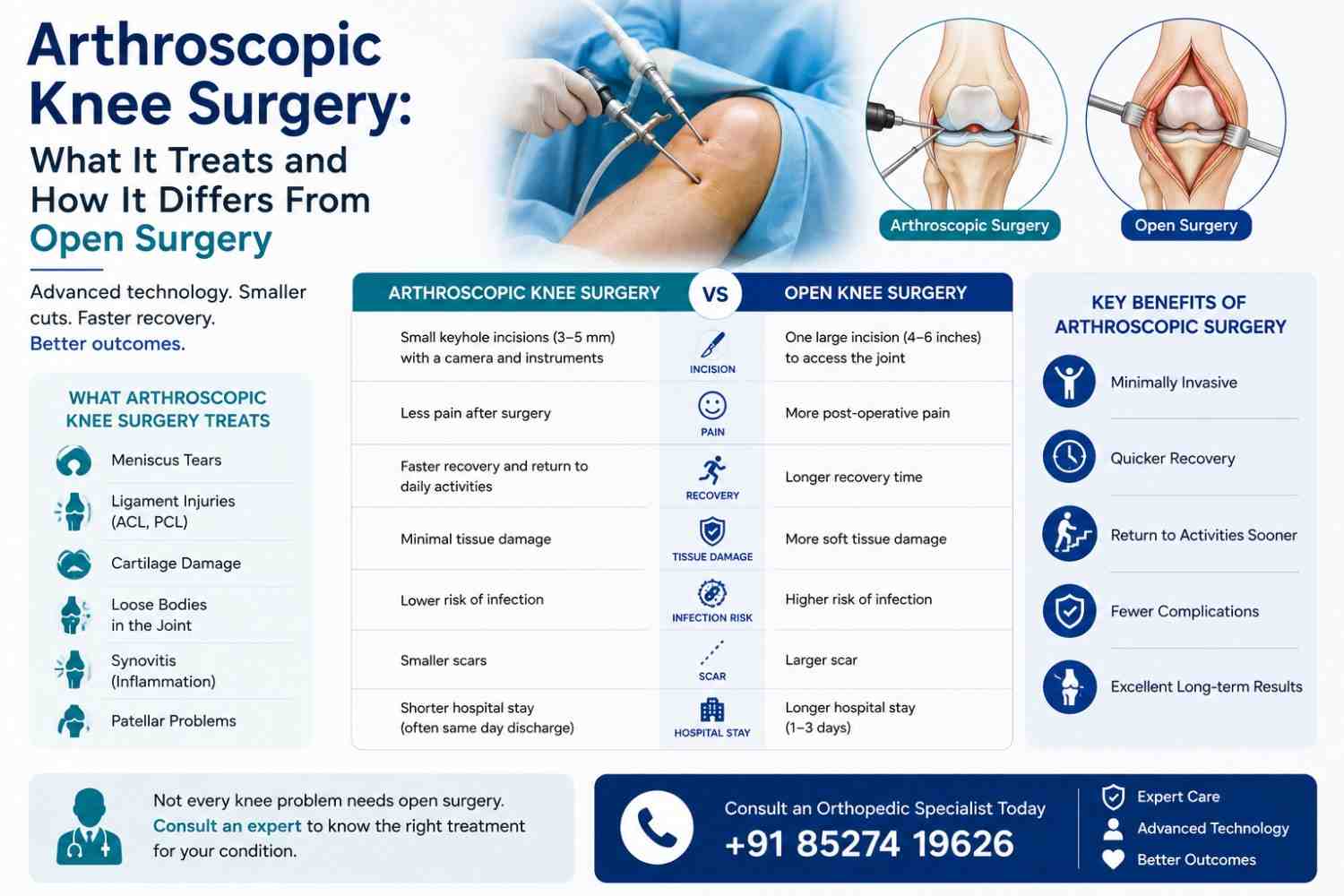
Arthroscopic Knee Surgery: What It Treats and How It Differs From Open Surgery
Arthroscopic knee surgery, a minimally invasive surgical technique performed through several small incisions rather than one larger surgical opening, has genuinely and fundamentally changed the overall experience of treating many common knee conditions over the past few decades. Understanding what it treats, and genuinely how it differs from traditional open surgery, helps clarify why it's become the standard approach for such a wide range of knee problems.
How Arthroscopic Surgery Actually Works
A small camera, called an arthroscope, is inserted through one small incision, typically less than a centimetre in length, providing the surgeon a magnified, high-definition view of the inside of the joint displayed clearly on a monitor throughout. Specialised surgical instruments are then carefully inserted through one or two additional small incisions to perform the actual repair or treatment work needed, all while the surgeon watches the entire procedure on screen rather than through direct open visualisation of the joint itself.
Conditions Commonly Treated Arthroscopically
Meniscus Tears
Torn meniscus cartilage, one of the most common knee injuries, can often be repaired or, when repair isn't appropriate, partially trimmed (partial meniscectomy) arthroscopically, addressing the specific damaged area with minimal disruption to surrounding healthy tissue.
ACL Reconstruction
Anterior cruciate ligament reconstruction, covered in our related articles on ACL injury symptoms and ACL surgery, is now almost universally performed arthroscopically, using a graft to reconstruct the torn ligament through small incisions.
Loose Bodies and Cartilage Fragments
Loose cartilage or bone fragments within the joint, which can cause locking, catching, or pain, can be located and removed arthroscopically with precision.
Cartilage Damage
Various cartilage repair and restoration techniques can be performed arthroscopically, addressing localised cartilage damage before it progresses to more widespread joint degeneration.
Diagnostic Evaluation
In select cases where imaging findings remain unclear, arthroscopy itself can provide direct diagnostic visualisation of the joint, allowing treatment of a confirmed problem within the same procedure.
How This Differs From Open Surgery
Incision Size and Tissue Disruption
Open knee surgery requires a single larger incision, providing direct visualisation but disrupting considerably more surrounding tissue, muscle, and other structures to access the joint, compared to arthroscopy's small, targeted incisions.
Recovery Time
Because arthroscopic surgery involves significantly less tissue disruption, recovery is generally faster, with many patients returning to daily activities considerably sooner than after equivalent open surgery, though the specific procedure performed still meaningfully affects the recovery timeline regardless of surgical approach.
Infection Risk and Scarring
Smaller incisions generally carry lower infection risk and produce significantly less visible scarring compared to open surgical approaches.
Postoperative Pain
Reduced tissue disruption generally translates to less postoperative pain compared to equivalent open procedures, though appropriate pain management remains an important part of recovery regardless of surgical approach.
When Open Surgery Is Still Necessary
Despite arthroscopy's advantages, certain complex reconstructions, some fracture repairs, and specific situations where direct, extensive visualisation or access is genuinely required still necessitate open surgical approaches. The choice isn't about arthroscopy always being universally "better," it's about matching the surgical approach to what the specific condition actually requires for a good outcome.
What Recovery Actually Looks Like
Recovery varies considerably by the specific procedure performed, a diagnostic arthroscopy or simple meniscus trim generally allows a much faster return to activity than an ACL reconstruction, which requires months of structured, progressive rehabilitation regardless of how small the incisions were. Our related article on arthroscopy surgery recovery time covers this in more detail, and our arthroscopic surgery practice provides a clear, individualised recovery timeline specific to each patient's actual procedure, rather than a generic "minimally invasive equals minimal recovery" assumption that doesn't hold for every arthroscopic procedure equally.
Preparing for Arthroscopic Surgery
Preparation typically includes a thorough pre-operative evaluation, imaging review, and a discussion of anesthesia options appropriate to the specific procedure. Patients are generally advised on medication adjustments beforehand, particularly for blood thinners or certain supplements that can affect bleeding risk, and given clear instructions about fasting before the procedure. Arranging appropriate support for the day of surgery and the initial recovery period, transport home, and help with daily tasks for the first few days, matters more than many patients initially expect, even for a procedure marketed as minimally invasive.
What Happens During the Immediate Postoperative Period
Most arthroscopic knee procedures are performed as day surgery or with a short overnight stay, with patients typically able to bear at least partial weight, guided by the specific procedure performed, within the first day. Small incisions are covered with simple dressings, swelling and mild discomfort are expected and managed with appropriate pain relief, and clear instructions are given about wound care, activity restrictions, and warning signs, increasing pain, fever, or spreading redness, that would warrant contacting the surgical team promptly.
Common Questions About Returning to Work and Daily Life
How quickly patients return to work and normal daily activities depends heavily on both the specific procedure performed and the physical demands of their job or lifestyle. A desk-based job often allows a return within days for simpler procedures, while physically demanding work or a full return to sport after a significant reconstruction like ACL surgery requires a considerably longer, carefully staged timeline. Getting a clear, personalised estimate from your surgical team, rather than relying on a generic timeframe found online, gives a far more accurate picture of what to actually plan for.
Discuss Arthroscopic Knee Surgery
Frequently Asked Questions (FAQs)
1. Can arthroscopic surgery be converted to open surgery during the procedure if needed?
In rare cases where the arthroscopic approach reveals a problem better addressed openly, surgeons may convert during the procedure, which is why this possibility is typically discussed as part of informed consent beforehand.
2. Is arthroscopic surgery always less painful than open surgery?
Generally yes, given the smaller incisions and reduced tissue disruption, though the specific procedure performed still significantly affects the overall pain and recovery experience.
3. Can all knee problems be treated arthroscopically?
Most common knee conditions can be treated arthroscopically, but some complex reconstructions or specific situations still require open surgical approaches for the best outcome.
4. How long does arthroscopic knee surgery itself typically take?
This varies by procedure, from around 30 minutes for simpler procedures to a few hours for more complex reconstructions like ACL surgery.
5. Is arthroscopic surgery performed under general anesthesia?
This depends on the specific procedure and patient factors; some arthroscopic procedures can be done under regional or spinal anesthesia, which your surgeon and anesthesiologist will discuss with you.
6. Does a faster recovery from smaller incisions mean less rehabilitation is needed?
Not necessarily, procedures like ACL reconstruction still require months of structured physiotherapy regardless of the small incision size, since the underlying tissue being repaired still needs time to heal and strengthen.
7. Are the results of arthroscopic surgery as good as open surgery?
For the wide range of conditions where arthroscopy is the appropriate approach, outcomes are generally equivalent or better than open surgery, with the added benefit of reduced tissue disruption.
This article is for educational purposes and does not replace personalized medical advice. Please consult a qualified physician before making changes to your treatment, medication, or health screening plan.
Related Articles
Meniscus Tear Symptoms: When Does a Knee Injury Need an MRI?
A twisting knee injury can affect the meniscus, a cartilage cushion inside the joint.
Total Hip Replacement vs Partial Hip Replacement: What's the Difference?
Total and partial hip replacement aren't interchangeable options for the same problem. Here's what actually distinguishes them and when each is used.
Recovering From a Sports Injury: Physiotherapy vs Surgery Decision Guide
The physiotherapy-versus-surgery decision after a sports injury isn't always obvious. Here's the framework surgeons actually use to make that call.