7 min read
How Long Does It Take to Recover After Arthroscopy Surgery?
Learn how long recovery takes after arthroscopy surgery, what affects healing, recovery timelines, rehabilitation tips, FAQs, and when to return to sports.
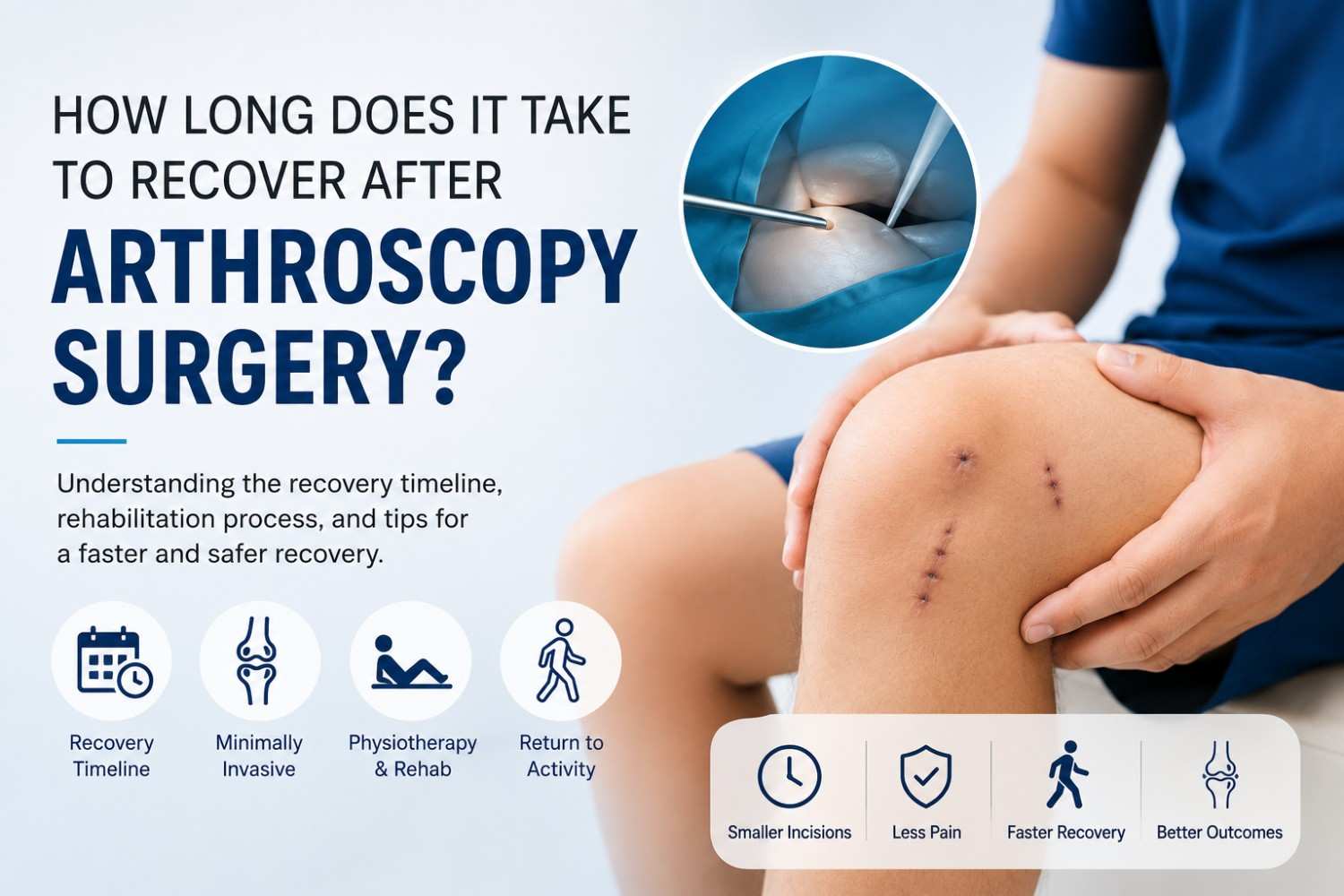
How Long Does It Take to Recover After Arthroscopy Surgery?
Arthroscopy surgery has transformed the way orthopedic conditions are treated. Instead of large incisions and lengthy hospital stays, this minimally invasive procedure allows surgeons to diagnose and treat joint problems through small incisions using a specialized camera called an arthroscope. Patients often choose arthroscopy because it usually results in less pain, smaller scars, and a faster recovery compared to traditional open surgery.
One of the most common questions patients ask before the procedure is, "How long will it take to recover after arthroscopy surgery?" While recovery is generally quicker than open surgery, the exact timeline depends on several factors, including the joint being treated, the severity of the injury, the procedure performed, and how well you follow your rehabilitation program.
If you are considering treatment, understanding the recovery process can help you prepare both physically and mentally. You can also learn more about the procedure on our Arthroscopy Surgery service page.
What Is Arthroscopy Surgery?
Arthroscopy is a minimally invasive orthopedic procedure used to diagnose and treat problems inside a joint. During the procedure, a tiny camera is inserted through a small incision, allowing the surgeon to examine the joint in detail. Additional small instruments may be used to repair damaged tissues, remove loose fragments, or reconstruct injured ligaments.
Arthroscopy is commonly performed on:
Knee joint
Shoulder joint
Ankle
Hip
Elbow
Wrist
It is frequently recommended for sports injuries, ligament tears, cartilage damage, meniscus injuries, shoulder instability, and persistent joint pain.
Why Is Recovery Different for Every Patient?
There is no single recovery timeline that applies to everyone. A simple diagnostic arthroscopy may require only a few weeks of recovery, while ligament reconstruction performed arthroscopically may take several months.
Recovery depends on:
The joint being treated
The severity of the injury
Your age and overall health
Your physical fitness before surgery
The exact procedure performed
Your commitment to physiotherapy
Patients who actively participate in rehabilitation usually regain mobility much faster than those who neglect their recovery exercises.
The Typical Arthroscopy Recovery Timeline
First 24–72 Hours
Immediately after surgery, mild pain, swelling, and stiffness are completely normal. Your orthopedic surgeon may recommend ice packs, pain medication, elevation of the affected joint, and gentle movement to reduce swelling.
Most patients return home on the same day because arthroscopy is usually performed as a day-care procedure.
Week 1
During the first week, your focus should be on protecting the joint while beginning gentle range-of-motion exercises. Depending on the procedure, your doctor may advise using crutches, a sling, or a brace temporarily.
Walking short distances is encouraged in many knee arthroscopy cases, but strenuous activities should be avoided.
Week 2 to Week 6
This is when most patients notice significant improvement. Swelling gradually decreases, pain becomes easier to manage, and movement improves considerably.
Physiotherapy becomes the most important part of recovery during this stage. Exercises focus on restoring flexibility, muscle strength, balance, and joint stability.
Patients recovering from sports-related injuries should closely follow rehabilitation protocols. If your arthroscopy was performed due to a ligament injury, you may also benefit from learning about our ACL Reconstruction Surgery services, where advanced treatment options for ligament injuries are available.
Two to Three Months
By this stage, many patients have resumed most routine daily activities. Walking becomes comfortable, joint movement improves significantly, and muscle strength continues to return.
However, patients involved in sports or physically demanding work may still require additional rehabilitation before returning safely to full activity.
How Physiotherapy Speeds Up Recovery
Many patients believe surgery alone fixes the problem. In reality, arthroscopy only repairs the damaged tissue. Physiotherapy teaches your muscles and joints how to function normally again.
A structured rehabilitation program helps:
Reduce stiffness
Restore flexibility
Improve muscle strength
Prevent future injuries
Improve balance and coordination
Speed up return to normal activities
Patients recovering from sports injuries often require specialized rehabilitation programs. If your injury occurred during sports or physical activity, you may also find our Sports Injury Treatment page helpful for understanding comprehensive treatment options.
What Can Delay Recovery?
Although arthroscopy usually offers faster recovery than open surgery, several factors can slow down healing.
Ignoring physiotherapy sessions
Returning to sports too early
Poor nutrition
Smoking
Uncontrolled diabetes
Excess body weight
Not following post-operative instructions
Following your surgeon's advice carefully is the best way to reduce complications and achieve a successful outcome.
When Should You Contact Your Orthopedic Surgeon?
Some discomfort is expected after arthroscopy, but certain symptoms require immediate medical attention. Contact your orthopedic surgeon if you notice:
Persistent fever
Increasing redness around the incision
Excessive swelling
Pus or wound discharge
Severe pain that continues to worsen
Difficulty moving the joint after initial improvement
Early treatment of complications can prevent more serious problems and improve recovery outcomes.
Can You Return to Sports After Arthroscopy?
Most patients can return to sports after arthroscopy, but only when the joint has healed completely and strength has returned. The timeline varies depending on the procedure performed. For example, a simple meniscus trimming procedure may allow an earlier return than an ACL reconstruction performed arthroscopically.
Returning too early increases the risk of re-injury. Your orthopedic surgeon and physiotherapist will evaluate your strength, flexibility, balance, and joint stability before clearing you for sports or high-impact activities.
Tips for a Faster and Safer Recovery
While healing takes time, following healthy habits can improve recovery and reduce the chances of complications.
Attend every physiotherapy session.
Perform home exercises regularly.
Eat a protein-rich diet with adequate calcium and Vitamin D.
Maintain a healthy body weight.
Avoid smoking and excessive alcohol.
Do not skip follow-up appointments.
Increase activity gradually rather than rushing recovery.
Recovery is not about how quickly you walk—it is about regaining full joint function safely. Patience and consistency usually produce the best long-term results.
Is Arthroscopy Better Than Open Surgery?
For many orthopedic conditions, arthroscopy offers several advantages over traditional open surgery. Since the procedure uses small incisions, patients generally experience less pain, minimal blood loss, lower infection risk, and faster rehabilitation.
However, arthroscopy is not suitable for every condition. Complex fractures, advanced arthritis, or extensive joint damage may still require open surgical procedures. Your orthopedic surgeon will recommend the most appropriate option based on your diagnosis.
Frequently Asked Questions
1. How long does it take to recover after arthroscopy surgery?
Most patients recover from simple arthroscopy within 4–6 weeks, while more complex procedures like ligament reconstruction may require 6–9 months of rehabilitation.
2. Is arthroscopy a major surgery?
No. Arthroscopy is considered a minimally invasive procedure because it is performed through very small incisions using a camera and specialized instruments.
3. When can I start walking after arthroscopy?
Many patients begin walking on the same day or the next day after surgery, although weight-bearing recommendations depend on the procedure performed.
4. Will I need physiotherapy after arthroscopy?
Yes. Physiotherapy is one of the most important parts of recovery. It restores strength, flexibility, joint stability, and helps reduce the risk of future injuries.
5. Can arthroscopy treat sports injuries?
Yes. Arthroscopy is commonly used to treat meniscus tears, ligament injuries, cartilage damage, shoulder instability, and several other sports-related conditions. Learn more about our Sports Injury Treatment services.
6. When should I book a consultation?
If you have persistent joint pain, locking, swelling, instability, or difficulty performing daily activities despite medication or physiotherapy, consult an orthopedic specialist for evaluation. You can book a consultation here.
Final Thoughts
Arthroscopy surgery has helped thousands of patients return to pain-free movement with less discomfort and quicker recovery than traditional open procedures. While healing time varies from person to person, following your surgeon's advice, attending physiotherapy, and allowing your body adequate time to heal are the keys to achieving the best outcome.
Whether your arthroscopy is performed for a sports injury, cartilage damage, meniscus tear, or ligament reconstruction, understanding the recovery process allows you to set realistic expectations and actively participate in your rehabilitation.
If you're experiencing persistent joint pain or have been advised to consider arthroscopy, learn more about our Arthroscopy Surgery services or schedule a consultation to discuss the most appropriate treatment for your condition.
Related Articles
Ankle Sprain Recovery Timeline: Walking to Sport
A practical ankle sprain recovery timeline covering early care, safe walking, exercises, return to running, and signs that may indicate a fracture.
Running Injuries: Prevention and Care
A practical guide to common running injuries, prevention, early care, warning signs, orthopaedic assessment, and a safe return-to-running progression.
When Is Hip Replacement Really Necessary?
Hip replacement may be considered when persistent pain, stiffness and loss of function continue despite appropriate non-surgical treatment.