7 min read
Growth Plate Fractures in Children: A Parent Guide
Learn the signs of a growth plate fracture in a child, why it may resemble a sprain, and how treatment and longer follow-up protect growth.
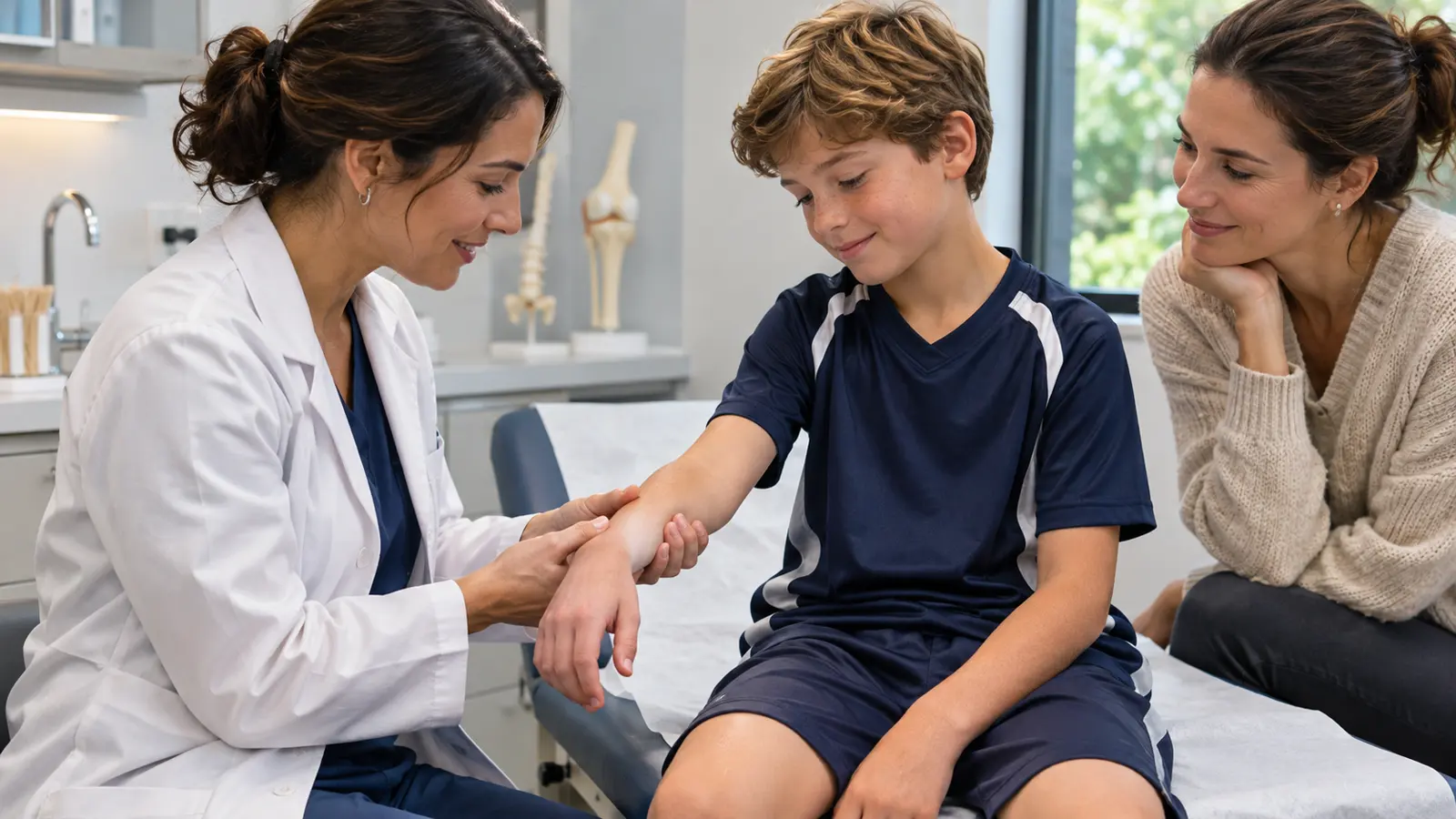
Growth Plate Fractures in Children: A Parent Guide
A child falls on an outstretched hand, has swelling near the wrist, and can still wiggle the fingers. It is tempting to call it a sprain. In a growing child, however, pain near the end of a bone can involve the growth plate, a region that adults no longer have. Some injuries look subtle on an early X-ray. The reason to assess them carefully is not that every injury will cause a growth problem, but that the treatment and follow-up may differ from an ordinary adult fracture.
This guide explains how growth plate fractures happen, what symptoms parents should notice, and why follow-up matters. Our general fracture emergency guide covers immediate trauma care across ages. Here the focus is on the special growth area in children and teenagers. If your child has a new injury, a direct clinical assessment is more useful than matching their symptoms to a photograph online.
What is a growth plate?
Growth plates are areas of developing tissue near the ends of many long bones. They contribute to the bone's length and shape during childhood and adolescence. As growth finishes, these plates close and become mature bone. That is why a growth plate fracture is a child or adolescent injury rather than an adult diagnosis.
The location matters. Growth plates are near joints such as the wrist, ankle, knee, and elbow. A fall, twist, or sports collision may injure the bone and plate at the same time. The American Academy of Pediatrics explanation of childhood fractures notes that damage to a growth plate can sometimes affect future growth if it does not heal properly. Most injuries do heal, but the possibility changes how clinicians assess and monitor them.
Why can a child's “sprain” be different?
In adults, a force near a joint may stretch or tear a ligament. In a child, the growing region of bone can be a relatively vulnerable point, so the same type of force may cause a fracture. The AAP sports injury guidance warns that growth plate injuries can be confused with sprains or strains. This does not mean every sore ankle is fractured. It means persistent focal tenderness near a plate deserves careful evaluation.
Age and sport also matter. A younger child may injure a growth plate after a simple fall, while a teenager may be injured during jumping, running, or contact sport. Repeated overload can produce other growth-related injuries. The doctor needs the exact mechanism, where the child points to pain, and whether they can bear weight or use the limb normally.
What symptoms should parents look for?
Common clues include pain at a specific spot near a joint, swelling, tenderness, bruising, refusal to use the arm or leg, limping, or reduced movement. A child who can move the fingers or toes can still have a fracture. Similarly, a child who does not cry much may still be hurt. The severity of pain alone does not reliably identify the type of injury.
A visibly bent limb, open wound, severe pain, numbness, blue or pale fingers or toes, or inability to put weight on the leg needs prompt medical care. Do not try to straighten a deformed limb yourself. If a cast is later applied, review our cast warning signs guide for a separate set of urgent symptoms. A tight cast problem is different from the original growth plate injury but deserves equal attention.
How is a growth plate injury diagnosed?
The clinician examines the tender area, movement, circulation, and nerves, then selects imaging based on the injury. Plain X-rays are often the starting point. Because a growth plate is not identical to solid adult bone on an X-ray, some injuries may be difficult to see initially. A doctor may treat a strongly suspected injury and arrange reassessment even when the first image seems reassuring.
Additional imaging is not routine for every child. CT or MRI may be considered when the joint surface, alignment, or injury pattern needs more detail, or when the diagnosis remains uncertain. Ask what a proposed scan will change in treatment. A photograph of swelling cannot tell whether the plate is involved, and a normal-looking wrist after a few days does not automatically remove the need for a planned follow-up.
What determines treatment?
Treatment depends on which bone and growth plate are affected, whether the pieces remain aligned, whether a joint surface is involved, and the child's age and remaining growth. Some injuries need a splint or cast and monitoring. Others need the bone put back into position, sometimes with a procedure. More complex or displaced injuries may require surgery. There is no single “growth plate treatment” that fits every location.
The aim is to protect healing while maintaining good alignment and joint function. Parents should understand how long the limb should be protected, whether the child may bear weight, when the cast or splint will be checked, and which activities are restricted. Do not remove a splint early because pain has improved. Healing comfort and safe return to load are related but not identical.
Why does follow-up continue after the cast comes off?
Some complications only become visible as the child grows. The AAP childhood fracture guide explains that an effect on growth can appear months later and that selected growth plate injuries require careful longer follow-up. The exact schedule depends on the site and severity. Missing an appointment because the child feels fine can remove the opportunity to spot a developing difference early.
Doctors may compare alignment, limb length, joint motion, and symptoms over time. A child with a wrist injury may be monitored differently from one with an injury around the knee. Ask your treating surgeon what change should prompt a sooner visit: a new deformity, increasing difference between sides, persistent pain, or difficulty returning to activity.
Can a growth plate fracture cause a shorter limb?
It can in a minority of cases, particularly if the injury disturbs growth at a plate with substantial growth remaining. The degree and risk vary widely. Most parents should not assume a visible difference will develop. The reason to follow the plan is to detect a problem if it arises and discuss options at the right time. An early X-ray alone may not predict the child's final limb length.
The same principle applies to an angled growth pattern near a joint. A child may recover from the initial fracture but later develop an alignment change. Monitoring allows a specialist to distinguish normal variation from a progressive issue. Our children's knock knees article discusses a different common alignment question and should not be used to judge a post-fracture deformity.
Return to school and sport
Comfortable use of the limb for daily activity usually returns before contact sports are safe. The treating team should give instructions based on the fracture, healing, cast removal, strength, and joint motion. A child should not be pushed to play through pain or conceal symptoms to meet a tournament date. If rehabilitation is advised, follow the specific plan rather than copying adult exercises online.
Parents can prepare by telling the school about restrictions on running, playground activity, writing, or carrying a bag. Keep a copy of the medical note and follow-up date. When the child returns to sport, build load gradually and report renewed focal pain. A new injury after recovery needs fresh assessment; it should not automatically be blamed on the old fracture.
Questions to ask at the first appointment
Ask where the suspected fracture is, whether the growth plate or joint is involved, and whether alignment is acceptable. Ask what signs would require urgent review, how to care for the cast, and when the next examination or X-ray is planned. Ask how long growth will be monitored and when school and sport activities can resume. If imaging is inconclusive, ask why the clinician still suspects or excludes a growth plate injury.
If the child has swelling, severe pain, or circulation symptoms after a cast, contact the treating team promptly. Do not wait for the scheduled review. Clear instructions, careful follow-up, and activity guidance are as important as the initial X-ray result.
Frequently asked questions
Can a growth plate fracture be invisible on the first X-ray?
Some injuries are difficult to see early. The examination and the exact site of tenderness may lead a clinician to protect the limb and reassess despite an apparently normal image.
Does every growth plate fracture need surgery?
No. Many are treated with immobilisation and follow-up. Displacement, joint involvement, and other features may make a procedure necessary.
If my child can move the limb, can I rule out a fracture?
No. Movement alone does not rule one out. Persistent focal pain or swelling after an injury merits evaluation.
Will the injured bone definitely stop growing?
No. Growth disturbance is a possibility, not a certainty. The risk depends on the injury and location, which is why follow-up is individualised.
When can my child return to sport?
Follow the treating clinician's plan. Pain improving is encouraging, but safe return also depends on healing, motion, strength, and the demands of the sport.
This article is educational and cannot replace an examination of an injured child.
Related Articles
बच्चा पैर अंदर रखकर चलता है: कब जांच जरूरी है?
बच्चा पैर अंदर रखकर चलता है? जानें intoeing के आम कारण, कब जांच जरूरी है और विशेष जूते या surgery की जरूरत कब हो सकती है।
Bone Density Test After a Fracture: Who Needs One?
A fracture may reveal underlying bone fragility. Learn who should discuss DXA testing and how to reduce the risk of another fracture.
कंधा बार-बार उतरता है: क्या Surgery जरूरी है?
कंधा बार-बार खिसकता या उतरता है? जानें जांच, physiotherapy, surgery पर विचार और किन लक्षणों में तुरंत मदद लेनी चाहिए।