6 min read
Trauma and Fracture Emergency Care: What Happens in the First 24 Hours
The first 24 hours after a serious fracture set the direction for everything that follows. Here's what actually happens during emergency orthopedic trauma care.
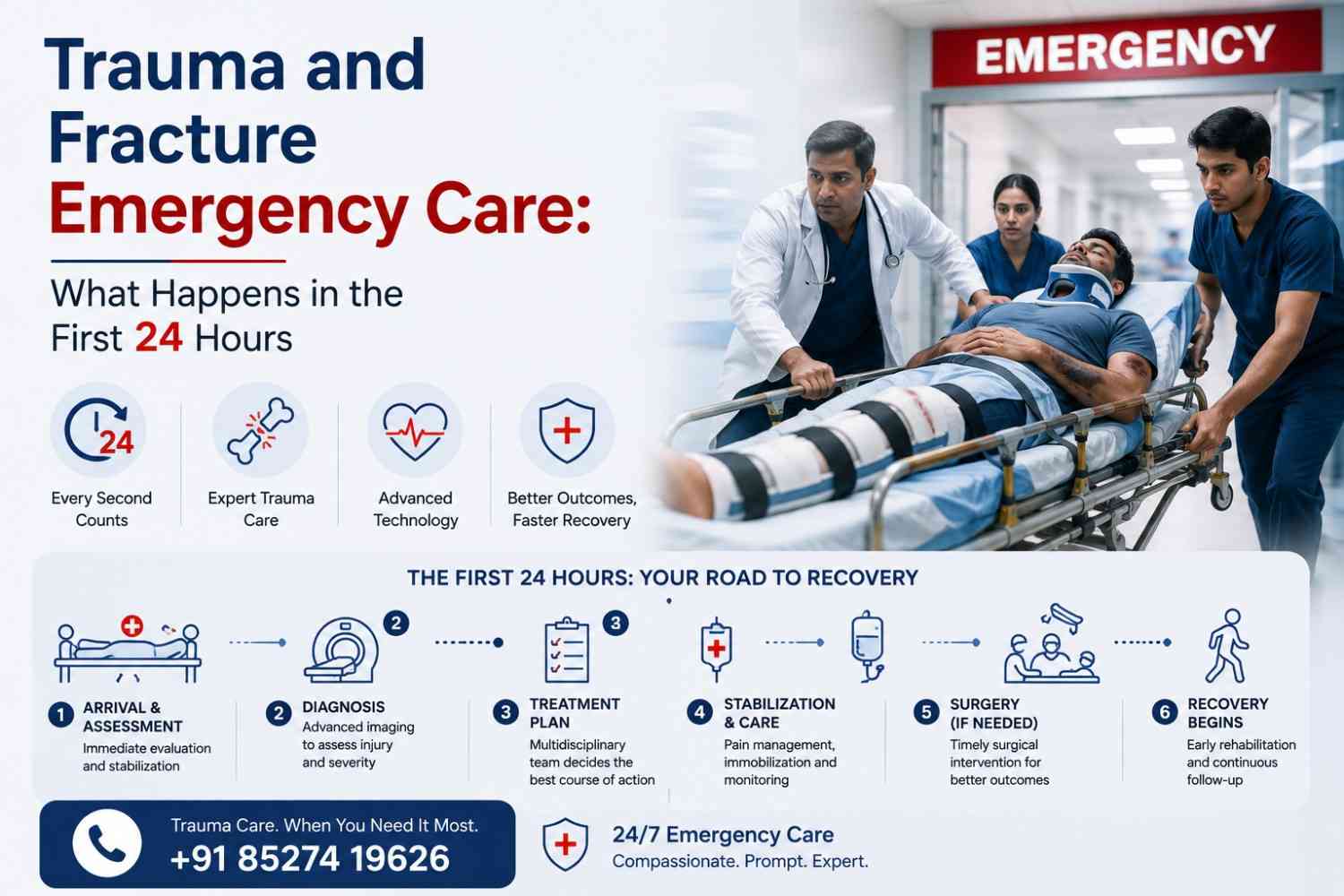
Trauma and Fracture Emergency Care: What Happens in the First 24 Hours
A serious fracture is a genuine medical emergency, and what happens during the critical first 24 hours, both immediate first aid and the subsequent hospital evaluation and treatment that follows, significantly influences both immediate safety and longer-term functional outcome down the line. Understanding this process, even in general terms, helps patients and families know what to expect during a stressful, disorienting situation.
Immediate First Aid Before Reaching Care
If you suspect a fracture has occurred, avoid moving the affected limb unnecessarily, immobilise it as best as possible with whatever is available nearby (a splint, rolled towel, or similar), and seek emergency medical care as promptly as you reasonably can. For open fractures, where bone has broken through skin, cover the wound with a clean cloth without attempting to push anything back into place, and control any significant bleeding with direct pressure while awaiting professional care.
What Happens on Arrival at the Hospital
Initial Assessment and Stabilisation
For any significant trauma, initial assessment prioritises overall patient stability, airway, breathing, circulation, and identifying any other injuries beyond the obvious fracture, before focusing specifically on the fracture itself. This broader assessment matters because significant trauma, a car accident or a serious fall, for example, can cause injuries beyond what's immediately visible or painful.
Imaging
X-rays typically confirm the fracture and reveal its specific pattern, whether it's a clean break, comminuted (broken into multiple pieces), or displaced (bone fragments out of normal alignment), all of which significantly influence treatment decisions. CT scans are sometimes needed for more complex fractures, particularly those involving joints, to fully understand the injury before planning treatment.
Pain Management
Appropriate pain relief is provided throughout, and shouldn't be something patients or families feel they need to specifically request or advocate hard for, it's a standard part of emergency fracture care.
Determining Treatment: Casting vs Surgery
Not every fracture requires surgery. Stable fractures in good alignment can often be treated with casting or splinting alone. Fractures that are significantly displaced, unstable, involve a joint surface, or carry a high risk of not healing properly without surgical fixation typically need surgical treatment, sometimes urgently, sometimes after initial stabilisation allows swelling to reduce first.
Why Timing Matters for Certain Fractures
Some fractures, particularly open fractures (where infection risk from the break in the skin is a significant concern) or fractures compromising blood supply to the limb, need surgical treatment genuinely urgently, within hours rather than days. Others can safely wait a day or more for swelling to subside before surgical fixation, which sometimes actually produces a better surgical outcome. This distinction, urgent versus appropriately delayed, is a clinical judgment made based on the specific fracture pattern and the patient's overall condition, not a one-size-fits-all rule.
What Families Should Expect
The pace of decision-making in trauma care can feel disorienting, moving from evaluation to a treatment plan sometimes within hours. It's reasonable to ask the treating surgeon directly about the specific fracture pattern, why a particular treatment approach (casting versus surgery) is being recommended, and what the expected recovery timeline looks like, rather than feeling that these questions are an interruption during an already stressful process.
After Initial Treatment
Once the fracture is stabilised, whether through casting or surgery, the recovery process shifts toward monitoring healing through follow-up imaging, managing pain, and, at the appropriate point in healing, beginning physiotherapy to restore strength and range of motion. Our trauma care practice manages this full continuum, from the initial emergency evaluation through complete functional recovery, rather than treating the fracture itself as the endpoint of care. For fractures affecting the hip specifically, our related article on total versus partial hip replacement explains the specific surgical decision-making involved.
Fractures in Elderly Patients: A Different Set of Considerations
Fractures in older patients, particularly hip fractures, carry additional considerations beyond the bone injury itself. Underlying bone density (osteoporosis), other existing medical conditions affecting surgical risk, and the significant risks of prolonged immobility, including blood clots, muscle wasting, and loss of independence, all factor into treatment planning. This is part of why hip fractures in elderly patients are generally treated as an urgent surgical priority in most cases, since early surgery and early mobilisation meaningfully reduce these downstream risks compared to prolonged bed rest, even when the surgical risk itself might seem to argue for a more cautious, delayed approach.
Preventing Falls and Future Fractures
Once initial fracture treatment is complete, addressing the underlying factors that contributed to the injury, bone density evaluation where relevant, home safety assessment for fall hazards, and balance-focused physiotherapy, meaningfully reduces the risk of a future fracture, particularly important for older patients who have already experienced one fragility fracture, since a first such fracture meaningfully raises the risk of a second.
Frequently Asked Questions (FAQs)
1. Is it normal to feel numbness around a fracture site?
Mild numbness can occur from swelling or the injury itself, but new, significant, or worsening numbness should be reported to the medical team promptly, since it can indicate nerve or circulation involvement.
2. Can a cast be adjusted if swelling changes significantly after application?
Yes, if a cast becomes too tight or too loose as swelling changes, it should be evaluated and adjusted promptly rather than left as is, to avoid complications.
3. Can someone walk on a fractured foot or ankle?
This varies by fracture type and severity; some stable fractures allow limited weight-bearing while others require complete non-weight-bearing, which is why professional evaluation, not personal judgment, should guide this.
4. Can a fracture be missed on an initial X-ray?
In rare cases, particularly with certain stress fractures or subtle injuries, yes, which is why persistent pain despite a normal initial X-ray sometimes warrants follow-up imaging or a different imaging modality.
5. Should I try to realign a visibly displaced fracture myself?
No, this should only be done by medical professionals. Attempting to realign a fracture yourself risks further damage to surrounding tissue, nerves, or blood vessels.
6. Do all fractures require surgery?
No, many stable, well-aligned fractures heal well with casting or splinting alone. Surgery is generally reserved for unstable, significantly displaced, or joint-involving fractures.
7. Why do some fractures need surgery urgently while others can wait?
This depends on factors like whether the fracture is open, whether blood supply to the limb is compromised, and overall fracture stability, all assessed individually by the treating surgeon.
8. How long does it typically take for a fracture to heal?
This varies considerably by bone, fracture severity, and individual factors, ranging from a few weeks for smaller bones to several months for more significant fractures.
9. Is physiotherapy always needed after a fracture heals?
For many fractures, particularly those affecting joints or requiring a period of immobilisation, physiotherapy plays an important role in restoring full strength and range of motion.
10. What should I bring to the hospital for a suspected fracture?
Focus on getting to care promptly rather than gathering items; hospital staff will guide you through the necessary steps once you arrive.
This article is for educational purposes and does not replace personalized medical advice. Please consult a qualified physician before making changes to your treatment, medication, or health screening plan.
Related Articles
Knee Replacement Infection: Early Warning Signs and When to Contact Your Surgeon
Learn the early and late warning signs of infection after knee replacement, when to contact the surgical team, and why prompt assessment matters.
घुटने में बार-बार सूजन या पानी क्यों भरता है? कब Orthopedic Doctor को दिखाएं?
घुटने में बार-बार सूजन, पानी भरने और जकड़न के सामान्य कारण समझें। जानें कब घर पर देखभाल ठीक है और किन संकेतों में तुरंत डॉक्टर को दिखाना चाहिए।
Partial vs Total Knee Replacement: Who Is a Good Candidate?
Understand how partial and total knee replacement differ, which findings affect candidacy, and why the final decision requires symptoms, examination and imaging together.