7 min read
Tennis Elbow vs Golfer's Elbow
Tennis elbow and golfer’s elbow explained: pain location, causes, diagnosis, rehabilitation and when to see an orthopedic doctor.
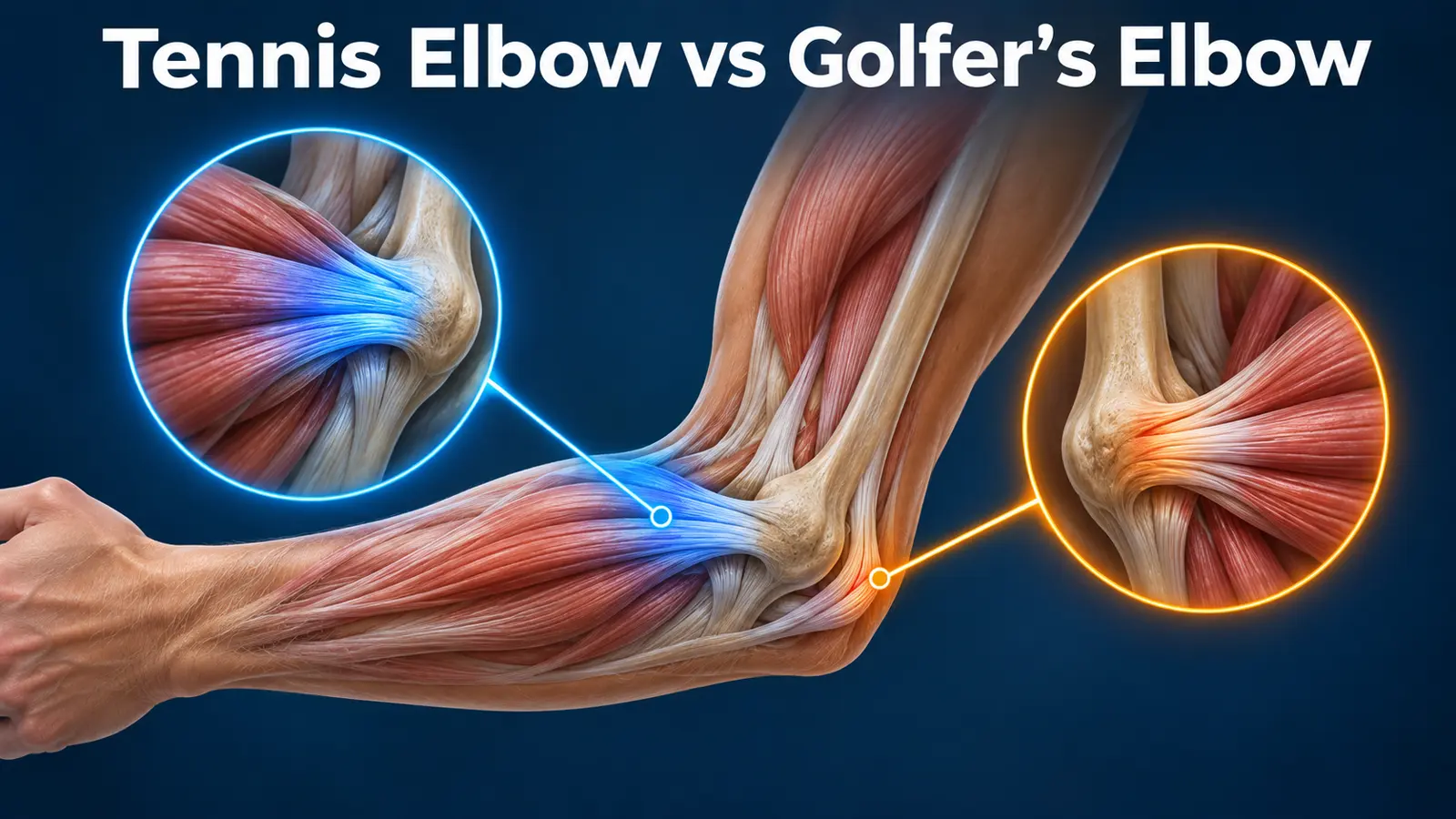
Tennis Elbow vs Golfer's Elbow
Pain on the outside or inside of the elbow is often called tennis elbow or golfer's elbow. The names suggest a sports injury, but many people who develop these problems have never played either sport. Repeated gripping, lifting, tool use or other forearm loading can irritate the tendons where they attach around the elbow. The location and movements that provoke pain help distinguish the two, although other causes can mimic them.
This guide explains the differences, how a doctor evaluates elbow pain and what recovery usually involves. It is separate from our shoulder pain at night article, which addresses a different joint and set of diagnoses. If pain follows a fall, the elbow is visibly deformed, or hand weakness is sudden, seek assessment rather than assuming a tendon problem.
Where does tennis elbow hurt?
Tennis elbow, or lateral epicondylitis, generally causes tenderness over the outer bony part of the elbow. Pain may travel into the forearm and worsen when lifting with the palm down, gripping, shaking hands or extending the wrist against resistance. The common extensor tendon is involved. The term “tendinopathy” is often more accurate than assuming an acute inflammation in every case.
It may start gradually after an increase in repetitive activity. A person may first notice discomfort when carrying a shopping bag or using a computer mouse for long periods. The amount of pain does not always reveal how damaged a tendon is. A careful examination helps determine whether the pain is truly at the tendon attachment or referred from the neck, a nerve or another structure.
Where does golfer's elbow hurt?
Golfer's elbow, or medial epicondylitis, generally causes pain at the inner side of the elbow where wrist-flexor and forearm-pronator tendons attach. Gripping, wrist flexion or rotating the forearm can provoke it. Some patients also have irritation of the ulnar nerve nearby, which may cause tingling in the ring and little fingers. Numbness is a reason to describe the symptoms clearly rather than labeling everything “golfer's elbow.”
The AAOS elbow exercise programme addresses both lateral and medial epicondylitis, reflecting their similar rehabilitation principles. The exact exercises and loading should be adapted to the individual. A golfer can have tennis elbow, and an office worker can have golfer's elbow.
What causes these tendon problems?
Tendons adapt to load over time. A sudden increase in gripping, lifting or repetitive wrist activity can exceed current capacity. Work tasks, new gym exercises and racquet sports are possible triggers. Some people cannot identify a single event. Recovery may be slow because the same daily tasks continue to load the area.
The goal is not complete avoidance of hand use. Prolonged rest can reduce strength and confidence. Instead, the clinician or physiotherapist often helps adjust aggravating tasks and rebuild tendon capacity gradually. A worker may need changes to grip size, breaks, tool position or load distribution. An athlete may need technique and training-load review.
How does an orthopedic doctor diagnose it?
The doctor asks where the pain is, how it started, what movements reproduce it and whether there is tingling, weakness or neck pain. Examination includes tenderness, resisted wrist and forearm movements, range of motion and sometimes nerve tests. A typical presentation often does not need immediate MRI. Imaging may be considered when the diagnosis is uncertain, symptoms are atypical or recovery is not progressing.
An X-ray may help rule out bone or joint problems in selected cases, but it cannot diagnose tendon health perfectly. Ultrasound or MRI may show tendon changes, yet imaging findings must match symptoms. A scan report alone should not lead to surgery. Our neck-to-arm pain guide explains why nerve symptoms can require a different evaluation.
What else can cause elbow pain?
Arthritis, fracture, ligament injury, nerve entrapment, bursitis and referred pain are possible alternatives. Pain with significant swelling, redness, fever or loss of movement needs prompt evaluation. Sudden pain after trauma with inability to use the arm may require imaging. Tingling or numbness may point toward a nerve condition rather than a simple tendon problem.
The location helps, but it does not replace examination. Pain in the middle of the joint or behind the elbow may have a different cause from pain over a tendon attachment. If both inner and outer sides hurt, the clinician should not force the symptoms into one label without checking the whole arm.
What helps in early recovery?
Reduce the most provocative loads temporarily and keep the arm moving within tolerable limits. Cold or heat may offer short-term comfort for some people. Medicines for pain should be chosen with a clinician or pharmacist, especially if you have kidney disease, high blood pressure, stomach ulcers or other medicines. A brace may help some tasks, but it is not a cure and should not become a substitute for rehabilitation.
Physiotherapy often uses progressive strengthening of the wrist and forearm, along with shoulder and grip work when relevant. The starting load should be tolerable. A little soreness during exercise may be acceptable in some programmes, but marked or prolonged worsening suggests the plan needs adjustment. Avoid copying a heavy eccentric exercise from a video on the first day.
Are injections useful?
Injections may be discussed for selected patients, but benefit and risk depend on the type and timing. A treatment that reduces pain quickly is not necessarily better for long-term tendon recovery. Evidence for different injections varies, and no single option reliably cures every case. Discuss expected benefit, how long it may last and whether rehabilitation remains necessary.
Avoid buying packages that promise a fixed number of sessions will restore the tendon. Many people improve with time and a structured loading plan, while some need further assessment. Decisions should be made after confirming the diagnosis and considering how much symptoms limit work and daily life.
When is surgery considered?
Surgery is not the first-line choice for most cases. It may be considered when symptoms remain substantial after a meaningful period of appropriate nonsurgical care and the diagnosis is clear. The surgeon should discuss what procedure is proposed, expected recovery and the possibility that pain may persist. Surgery should not be based on an MRI phrase alone.
The exact timeline varies with severity and prior treatment. If symptoms have lasted only a few weeks, the priority is usually load management and rehabilitation. If you have had months of pain, the doctor may review whether the programme addressed the right tendon and whether another cause was missed.
How can you return to sport or work?
Return gradually, starting with tasks that cause little or manageable discomfort. Increase load, duration and speed in stages while watching the next-day response. For racquet sports, grip size, technique and training volume may need adjustment. For work, tool design and short breaks can reduce repeated strain. The aim is to restore capacity rather than avoid the activity forever.
If pain returns sharply, reduce the load and review technique or diagnosis. A physiotherapist can help set practical milestones, such as carrying a bag, typing comfortably or playing a short session before full training. Recovery is not always linear, and a temporary flare does not automatically mean new damage.
Frequently asked questions
Does tennis elbow only happen to tennis players?
No. Repeated gripping and forearm loading in work or daily life can also contribute.
Which side is golfer's elbow?
It usually causes pain on the inner side of the elbow. Tennis elbow is usually on the outer side.
Do I need an MRI immediately?
Often not. History and examination commonly guide initial care. Imaging is considered when the diagnosis or progress is unclear.
Should I stop using my arm completely?
Usually not. Adjust painful loads and follow a graded strengthening plan rather than prolonged total rest.
Can tingling be part of golfer's elbow?
It can coexist with nearby ulnar nerve irritation, but tingling deserves assessment rather than being assumed to be tendon pain.
Will a brace cure it?
A brace may reduce discomfort during some tasks, but rehabilitation and load management remain important.
Related Articles
Leg Length After Hip Replacement
Why a leg may feel longer after hip replacement, how surgeons measure the difference, and when therapy or a lift may help.
Hip Replacement Dislocation: Signs and Next Steps
Learn the warning signs of hip replacement dislocation, when to seek urgent help, and how surgeons assess stability afterward.
Return to Sport After ACL Surgery: Readiness Tests
When can athletes return to sport after ACL reconstruction? Understand strength, hop, movement and psychological readiness tests.