7 min read
Hip Replacement Dislocation: Signs and Next Steps
Learn the warning signs of hip replacement dislocation, when to seek urgent help, and how surgeons assess stability afterward.
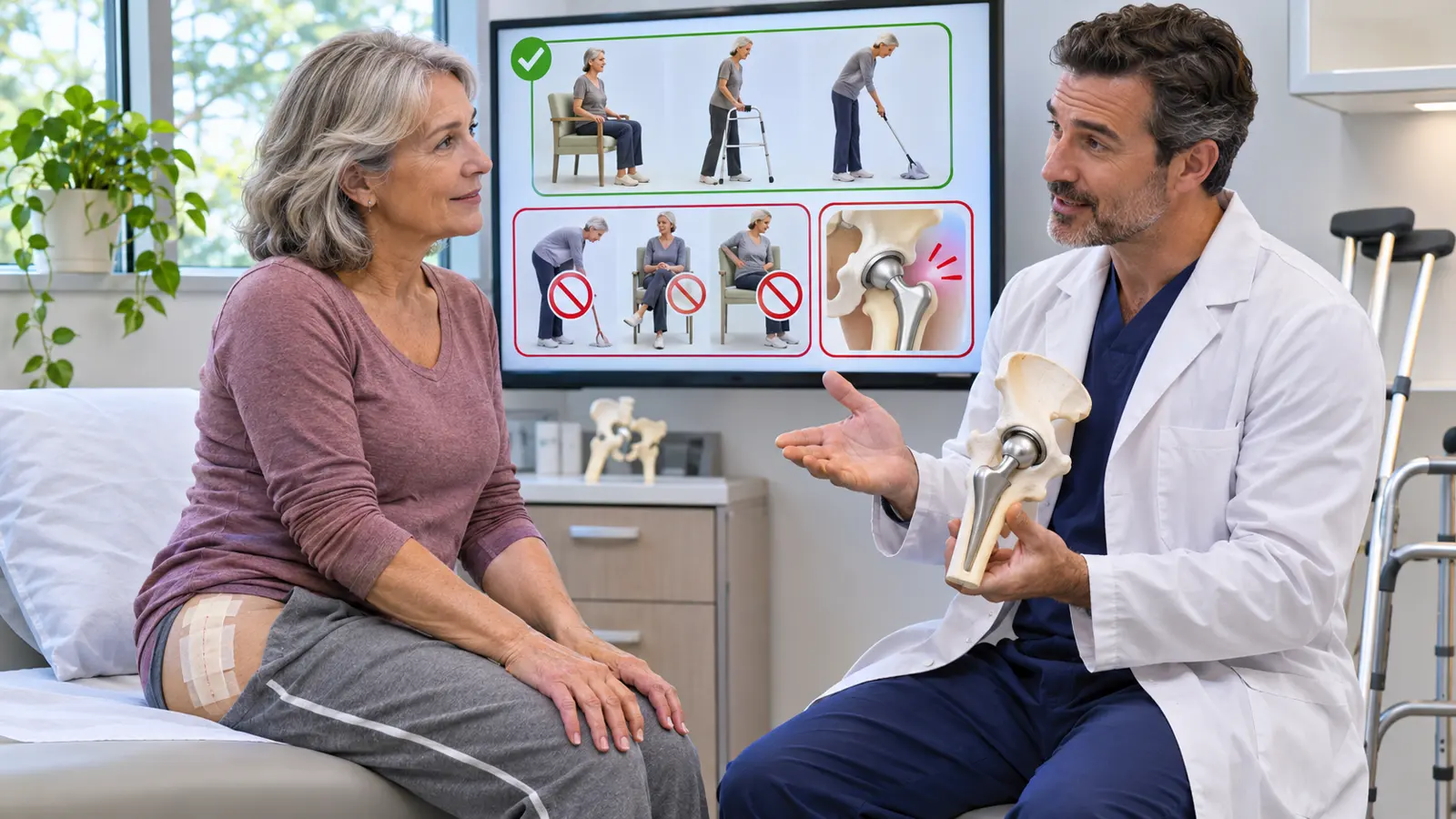
Hip Replacement Dislocation: Signs and Next Steps
A hip replacement can restore movement and reduce pain, but the artificial joint can occasionally dislocate. Dislocation means the ball of the implant moves out of its socket. It is uncommon for many patients, yet it requires prompt medical assessment when suspected. The most important signs are sudden severe hip or groin pain, an inability to move or bear weight, and a leg that looks unusually rotated or shorter. Do not try to push the joint back into place at home.
This guide focuses on recognizing dislocation and knowing what happens next. Our hip replacement recovery article covers the broader rehabilitation timeline. The details of precautions after surgery depend on surgical approach, implant, stability and your surgeon's instructions. A general list from the internet should never override your discharge plan.
What happens when a replaced hip dislocates?
During hip replacement, damaged joint surfaces are replaced with artificial components. The new ball and socket rely on component positioning, soft tissues, muscle function and patient movement for stability. If the ball comes out of the socket, the leg may become very painful and difficult to move. Some people describe a pop, but not everyone hears or feels one.
Dislocation is different from the expected soreness and stiffness of recovery. It can occur after a fall or a movement that places the hip in a vulnerable position, but sometimes the reason is not obvious. The AAOS hip replacement guidance explains that patients should follow individualized precautions while tissues heal. The presence or absence of a particular precaution does not guarantee whether a dislocation will occur.
Which symptoms need urgent help?
Sudden severe pain after a twist, fall or transfer, inability to stand or walk, and an obvious change in leg position are reasons for urgent assessment. Do not keep walking to “test” the joint. Avoid forcing the hip through movement or asking an untrained person to pull on the leg. Arrange safe transport and tell the emergency team that the person has a hip replacement.
Pain after surgery has many causes, and not every painful movement is a dislocation. However, a true dislocation cannot be diagnosed or safely treated by looking at a photograph. Imaging is usually needed. If there are signs of nerve or blood-flow problems, or if the patient has fallen and may have a fracture, the evaluation is especially urgent. Severe symptoms warrant emergency care.
Why risk can differ between patients
Risk depends on several factors, including prior hip surgery, muscle or nerve problems, component position, soft-tissue condition, falls and certain medical conditions. A revision hip replacement may have a different stability profile from a first replacement. Some people have restrictions early in recovery; others have fewer restrictions with a particular surgical approach. The surgeon should explain what applies to the patient's operation.
No single sitting posture causes every dislocation, and blanket claims about permanent restrictions are unhelpful. Ask specifically which movements to avoid, for how long, and which activities are encouraged. A physiotherapist can teach safe transfers, walking and home setup. If you have had a dislocation before, the team may provide additional advice based on what caused it.
What happens in hospital?
The team assesses pain, circulation, nerve function and possible associated injury. X-rays usually confirm the position of the implant and look for fracture or component problems. When appropriate, trained clinicians may use a procedure called closed reduction to guide the ball back into the socket, often with pain control or anesthesia. This is a medical procedure and must not be attempted at home.
After reduction, imaging and examination help confirm stability. The patient may need observation, a brace in selected circumstances, or changes to movement instructions. If the joint cannot be reduced safely, there is a fracture, or instability recurs, further surgery may be considered. The AAOS revision hip replacement resource describes why implant stability and component condition can matter in revision decisions.
Does one dislocation mean another operation?
Not necessarily. Some patients have a first dislocation treated without surgery and recover with a revised activity and rehabilitation plan. The choice depends on why it happened, whether the implant is stable after reduction, soft-tissue condition and the patient's needs. Recurrent dislocation calls for a closer evaluation of component position, impingement, muscle function and other factors.
It is reasonable to ask the surgeon what the likely trigger was and how confident the team is about it. A clear cause can guide precautions. Sometimes the cause remains uncertain, and follow-up becomes more important. Do not assume that a single event proves surgical error or that recurrence is inevitable.
Early recovery precautions
Patients may be taught how to sit, sleep, enter a car and use a toilet without placing the hip in a vulnerable position. The exact advice varies. A raised seat, grab bars or walking aid may help some patients but not everyone needs the same equipment. Follow your surgical team's written instructions and ask for a demonstration if a movement is unclear.
Avoid sudden twisting while the foot stays planted, especially if it causes discomfort or conflicts with your instructions. Use the recommended walking aid until the clinician says it can be reduced. Falls are a major concern in the early period, so remove loose rugs, improve lighting and plan for help with bathing or stairs when needed. Our hip pain when walking article discusses other causes of hip discomfort but does not replace post-surgical advice.
Can physiotherapy prevent dislocation?
Rehabilitation helps restore strength, balance and safe movement patterns. It may reduce some contributing risks, but it cannot guarantee that dislocation will never occur. The programme should match healing, the surgical approach and any associated procedures. Overly aggressive stretching or exercises copied from another patient's plan may be unsuitable early on.
Tell your physiotherapist if the hip feels unstable, painful in a new way or difficult to control during transfers. They can coordinate with the surgeon and adjust exercises. Progress is usually gradual, moving from safe walking and basic function toward more demanding activities. A strong recovery plan includes fall prevention and education, not only muscle exercises.
Questions to ask after a dislocation
Ask whether the implant components appear intact and well positioned, whether there was a fracture, and whether nerve or blood-flow findings were normal. Clarify which activities are temporarily restricted and for how long. Ask who will review your recovery and what new symptoms need immediate attention. If a brace is prescribed, request fitting and use instructions.
Also ask what the team believes contributed to the event and whether home transfers or equipment need changing. A family member who helps with mobility should hear the advice. If repeated instability occurs, ask what additional imaging or surgical options might be relevant and what benefits and risks each has.
When pain is not a dislocation
Muscle soreness, tendon irritation, spine problems, infection and fractures can cause pain after hip replacement. New fever, wound drainage, worsening swelling or persistent deep pain needs medical assessment even when the joint does not look dislocated. A normal-looking leg does not prove the implant is fine. Conversely, a painful hip can sometimes have a different and treatable cause.
Do not delay care because symptoms do not match a blog's checklist exactly. The surgeon's team can decide whether imaging, blood tests or another evaluation is needed. The safest step for sudden severe pain or inability to bear weight is urgent assessment.
Frequently asked questions
Can a hip replacement dislocate years later?
It can, although timing and causes vary. New trauma, implant wear or soft-tissue changes may be relevant. Any suspected dislocation needs assessment.
Can I push the hip back into place?
No. Attempting this at home can cause injury. Seek emergency care for evaluation and reduction by trained clinicians.
Does a pop always mean dislocation?
No. Sounds can have several causes. Sudden severe pain, inability to move or a changed leg position should be assessed urgently.
Will I need revision surgery?
One event does not automatically require revision. Recurrent instability, component problems or associated injury may change the recommendation.
Are hip precautions the same for everyone?
No. They depend on the operation and patient. Follow your surgeon's specific plan.
Can physiotherapy make the joint stable again?
Rehabilitation can improve strength and movement, but it cannot fix every mechanical cause of instability. The surgeon should assess recurrent events.
Related Articles
Return to Sport After ACL Surgery: Readiness Tests
When can athletes return to sport after ACL reconstruction? Understand strength, hop, movement and psychological readiness tests.
गर्दन से हाथ में दर्द: कब नस दबने का संकेत है?
गर्दन से हाथ में दर्द, झनझनाहट या कमजोरी क्यों होती है? Cervical radiculopathy के संकेत, जांच और कब तुरंत डॉक्टर को दिखाना चाहिए।
Meniscus Repair vs Meniscectomy: Which Preserves the Knee?
Compare meniscus repair and partial meniscectomy, including when tissue can heal, recovery differences and why preserving the meniscus matters.