6 min read
Total Hip Replacement vs Partial Hip Replacement: What's the Difference?
Total and partial hip replacement aren't interchangeable options for the same problem. Here's what actually distinguishes them and when each is used.
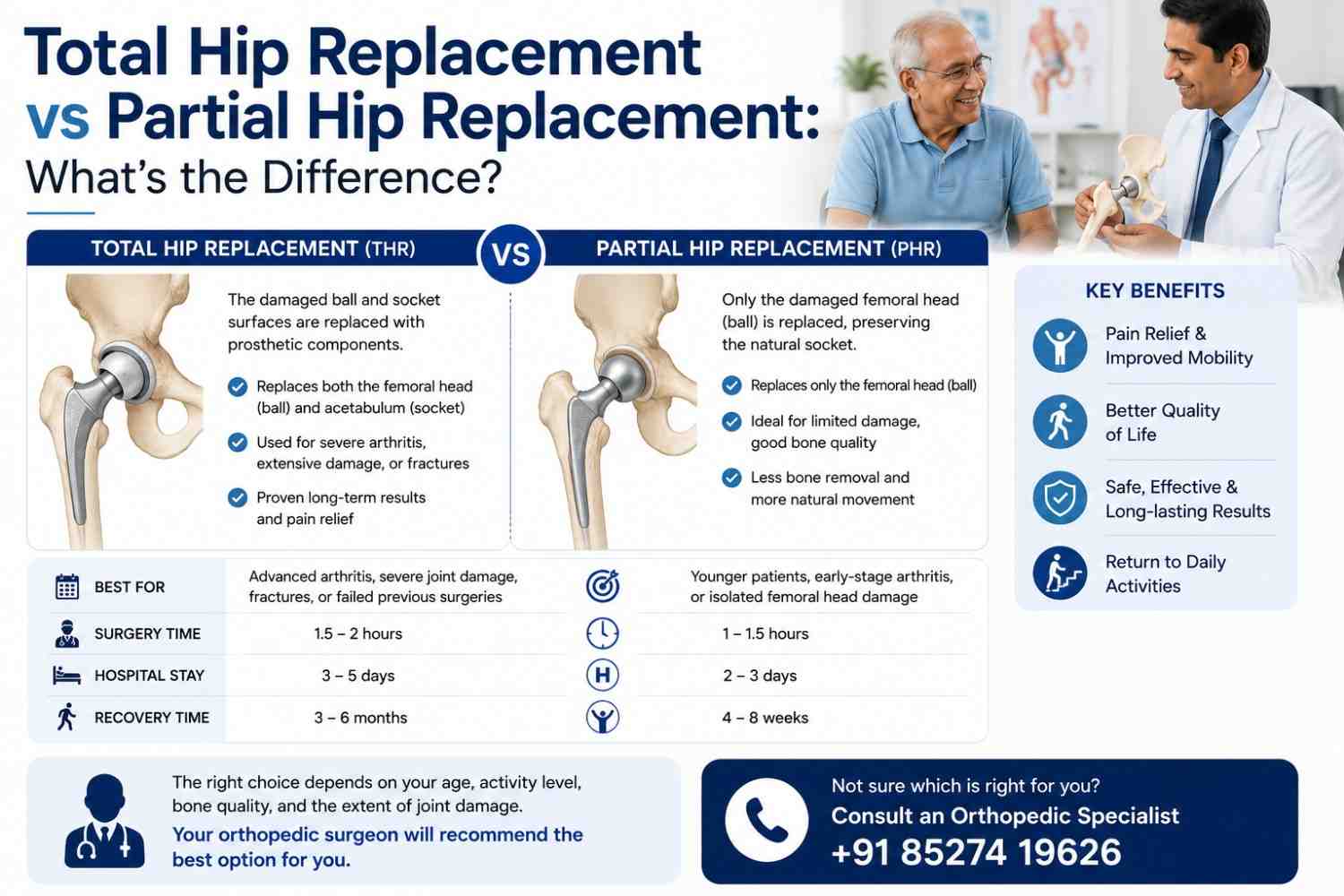
Total Hip Replacement vs Partial Hip Replacement: What's the Difference?
Hip replacement isn't a single, uniform procedure, total and partial hip replacement address different situations and involve genuinely different amounts of the joint. Understanding the distinction helps patients understand why their surgeon is recommending one specific approach over the other for their particular situation.
What Total Hip Replacement Involves
Total hip replacement replaces both sides of the joint: the femoral head (the ball at the top of the thigh bone) and the acetabulum (the hip socket in the pelvis). Both surfaces are resurfaced with prosthetic components, restoring a smooth, well-functioning joint on both sides of the articulation. This is the standard approach for hip osteoarthritis, where damage typically affects both the ball and the socket, as covered in our related article on hip replacement recovery.
What Partial Hip Replacement (Hemiarthroplasty) Involves
Partial hip replacement, also called hemiarthroplasty, replaces only the femoral head, leaving the natural hip socket in place. This is most commonly used for certain hip fractures, particularly in older patients, where the femoral head itself is damaged or its blood supply compromised by the fracture, but the socket remains healthy and undamaged.
Why the Distinction Matters
Different Underlying Problems
Osteoarthritis typically damages both sides of the joint over time through gradual wear, making total replacement the appropriate solution. A hip fracture, by contrast, often damages primarily the femoral head and its blood supply while leaving an otherwise healthy socket intact, making partial replacement a reasonable, less extensive option in appropriate cases.
Different Patient Populations
Partial hip replacement is more commonly used in older, often frailer patients following a hip fracture, where a shorter surgical procedure and generally quicker initial recovery carries real benefit, particularly when the patient's socket is confirmed healthy and lower demand activity levels reduce the relevance of the socket's long-term wear characteristics.
Different Long-Term Considerations
Total hip replacement generally provides more reliable long-term function for active patients, since both wearing surfaces are addressed. Partial replacement, while appropriate for its specific indication, carries some risk of the natural, unreplaced socket developing wear or pain over time, particularly in more active patients, which is why patient selection for this approach matters considerably.
How Surgeons Decide
The decision depends on the underlying cause (fracture versus osteoarthritis), the condition of the hip socket confirmed through imaging and sometimes direct surgical assessment, the patient's overall health and activity level, and, for fracture cases specifically, the classification and pattern of the fracture itself, all factors requiring genuine, individualised clinical judgment rather than a fixed rule applied to every hip.
Recovery Differences
Recovery follows a broadly similar path for both procedures, initial mobilisation typically beginning within a day of surgery, progressive physiotherapy, and gradual return to normal activity over weeks to months, though partial replacement in frailer, older patients following fracture is sometimes managed with a somewhat different pace and rehabilitation focus reflecting that patient population's specific needs and goals, often centred on restoring safe mobility and independence.
Getting the Right Procedure for Your Situation
Whether total or partial hip replacement is ultimately the right choice depends entirely on individual clinical findings and circumstances, not simply personal preference between the two available surgical options. Our hip replacement practice makes this determination based on thorough evaluation, including imaging and, for fracture cases, careful assessment of the specific fracture pattern and remaining joint health. Our related article on fracture emergency care covers the broader trauma evaluation process that often precedes this specific decision.
What Patients Can Expect After Either Procedure
Both procedures generally aim to relieve pain and restore functional mobility, allowing most patients to return to walking, daily activities, and, over time, many recreational activities they enjoyed before their hip problem developed. Physiotherapy plays a central role in both recovery pathways, focused initially on safe mobilisation and progressing toward strength and balance work that supports long-term independence, particularly important in the older patient population more commonly undergoing partial replacement after fracture.
Choosing an Experienced Surgical Team
Given the nuanced decision-making involved in choosing between these approaches, and the technical skill required for either procedure, choosing a surgical team with specific experience in hip surgery, comfortable managing both elective arthritis cases and urgent fracture cases, gives patients confidence that the recommended approach reflects genuine clinical judgment tailored to their situation, not a default habit applied regardless of individual circumstances.
Discuss Hip Replacement Options
Frequently Asked Questions (FAQs)
1. Is bone quality assessed before deciding between the two procedures?
Yes, bone density and quality are part of the overall evaluation, since they can influence both the surgical approach and the choice of implant used.
2. Can a partial hip replacement patient still participate in low-impact sports?
Many patients return to low-impact activities like walking, swimming, and cycling comfortably, though higher-impact activities are generally approached more cautiously given the unreplaced natural socket.
3. Can activity level change which type of replacement is recommended for a fracture?
Yes, a highly active older patient might be considered differently than a more sedentary one, since activity level affects how the natural socket is likely to hold up over time with a partial replacement.
4. How soon after hip replacement surgery can a patient walk again?
Most patients begin walking with support, often a walker initially, within a day of surgery, with independence progressively increasing over the following weeks under physiotherapy guidance.
5. Can both hips be replaced at the same time if both are affected?
In select cases yes, though this decision depends on overall health, surgical risk, and surgeon assessment, with staged surgery on each hip separately being more common.
6. Is partial hip replacement less invasive than total replacement?
It generally involves less extensive surgery since only one side of the joint is addressed, which can mean a somewhat shorter procedure, though both are significant surgeries requiring proper recovery.
7. Can partial hip replacement be converted to total replacement later?
Yes, if the natural socket develops significant wear or pain over time, conversion to total hip replacement is possible, though this is a consideration weighed during initial patient selection.
8. Why is partial hip replacement more common after fractures than for arthritis?
Because fractures typically damage the femoral head and its blood supply while leaving the socket intact, while arthritis typically affects both sides of the joint, making total replacement more appropriate.
9. Does partial hip replacement have a shorter recovery time?
Recovery timelines are broadly similar, though the patient populations differ somewhat, with fracture patients often being older and requiring rehabilitation focused on regaining safe independent mobility.
10. Is one type of hip replacement more durable than the other?
Total hip replacement generally offers more reliable long-term function for active patients, since both wearing surfaces are addressed, while partial replacement is specifically suited to its particular clinical indication.
11. Can a patient request total replacement instead of partial if partial is recommended?
This should be discussed directly with your surgeon, since the recommendation is based on clinical findings, the condition of the hip socket in particular, rather than personal preference alone.
This article is for educational purposes and does not replace personalized medical advice. Please consult a qualified physician before making changes to your treatment, medication, or health screening plan.
Related Articles
Knee Replacement Infection: Early Warning Signs and When to Contact Your Surgeon
Learn the early and late warning signs of infection after knee replacement, when to contact the surgical team, and why prompt assessment matters.
घुटने में बार-बार सूजन या पानी क्यों भरता है? कब Orthopedic Doctor को दिखाएं?
घुटने में बार-बार सूजन, पानी भरने और जकड़न के सामान्य कारण समझें। जानें कब घर पर देखभाल ठीक है और किन संकेतों में तुरंत डॉक्टर को दिखाना चाहिए।
Partial vs Total Knee Replacement: Who Is a Good Candidate?
Understand how partial and total knee replacement differ, which findings affect candidacy, and why the final decision requires symptoms, examination and imaging together.