7 min read
Meniscus Repair vs Meniscectomy: Which Preserves the Knee?
Compare meniscus repair and partial meniscectomy, including when tissue can heal, recovery differences and why preserving the meniscus matters.
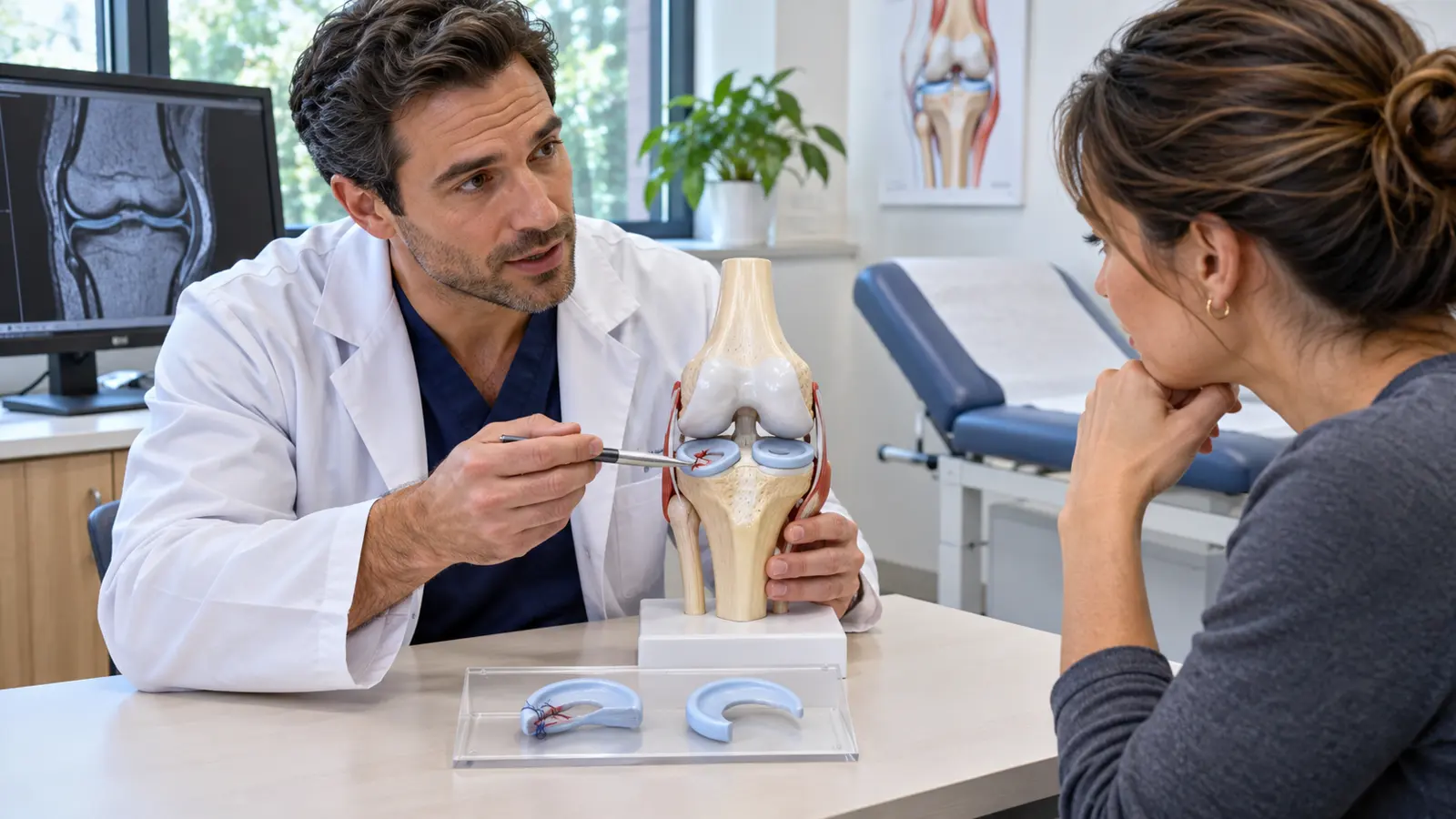
Meniscus Repair vs Meniscectomy: Which Preserves the Knee?
An MRI says “meniscus tear,” and the next question is whether the torn tissue should be repaired or partly removed. The answer is not determined by the word tear alone. Some tears have healing potential, some are degenerative, and some cause a locked knee or occur with an ACL injury. A good decision weighs symptoms, examination, tear pattern, age, activity goals, and the likely recovery demands of each option.
This article explains meniscus repair versus partial meniscectomy and why preserving functional meniscal tissue matters. Our meniscus MRI guide covers when imaging may be needed. Our ACL tear with meniscus injury article covers combined injuries. Here we focus on the choice between treating the meniscus with stitches and removing only the damaged portion when surgery is indicated.
What does the meniscus do?
The menisci are two crescent-shaped structures between the thighbone and shinbone. They help distribute load, contribute to stability, and protect joint surfaces. Removing a large amount of functional tissue can change how force passes through the knee. That is why surgeons generally try to preserve useful meniscus whenever feasible. Yet preserving a piece that cannot heal may not relieve a mechanical problem, so the goal is sensible preservation rather than repair at any cost.
A tear may follow a twist during sport or develop gradually with tissue degeneration. These are different clinical settings. A patient with an acute isolated sports tear should not assume the same recommendations as someone with a longstanding degenerative tear and arthritis. The AAOS acute isolated meniscus guideline explicitly applies to acute isolated tears and does not cover all chronic, degenerative, root, or combined ACL injuries.
What is a meniscus repair?
Repair means the surgeon brings suitable torn edges together, commonly using sutures or fixation devices, with the aim of healing and retaining tissue. Whether this can work depends on tear location, shape, quality of the tissue, blood supply, and stability of the knee. A repair may be especially attractive when a recent tear has good healing potential. The decision can change after arthroscopic inspection because an MRI does not show every important detail.
Repair usually demands a more protective recovery than a simple partial removal. Weight bearing, range of motion, and return to sport may be restricted for a period according to the tear and surgeon's protocol. That can be inconvenient, but the potential benefit is preserving tissue. There is also a chance the repair will not heal or symptoms will return. Discuss both the expected recovery and the possibility of further treatment before surgery.
What is partial meniscectomy?
Partial meniscectomy removes the torn or unstable portion while leaving as much healthy meniscus as possible. It may be chosen when the tissue cannot reasonably be repaired or when the tear pattern makes healing unlikely. It is not the same as removing the entire meniscus. A patient may progress through early recovery differently from someone after repair, but “faster recovery” does not mean it is automatically the best long-term choice.
The AAOS guideline announcement emphasises preserving as much functional meniscal tissue as possible when surgery is indicated for an acute tear. It also notes that repair can improve outcomes compared with partial meniscectomy for selected acute tears with healing potential, while the evidence strength is limited. This is a reason for an individual discussion, not a promise that repair always wins.
How do surgeons decide which option fits?
They consider the clinical story and examination first. Is the knee truly locking, or is it painful and stiff? Did symptoms begin after a clear twisting injury? Is there swelling, instability, or an ACL tear? Are X-rays showing arthritis? What does the MRI show about tear pattern and location? The answers help estimate whether a repair might heal and whether surgery is even needed.
The surgeon may plan a repair but discover during arthroscopy that tissue quality is poor, or may find a tear more repairable than the MRI suggested. Ask what the backup plan is and how consent covers that possibility. If preserving tissue is a priority for you, say so, while recognising that safety and the actual tissue condition guide the final choice.
Does every meniscus tear need surgery?
No. Symptoms, function, tear type, and other knee findings matter. Some people improve with activity modification, physiotherapy, and time. A degenerative tear in a knee with osteoarthritis often requires a different discussion from a displaced acute tear that blocks motion. The MRI finding alone should not be treated as an operation order.
If a knee is locked and cannot fully straighten, a timely assessment is important. If pain is mild and the knee is stable, a carefully supervised nonoperative plan may be reasonable. Neither choice should be made from a short internet checklist alone. Ask what problem surgery is expected to solve and how success will be judged.
Which option protects the knee from arthritis?
Keeping functional meniscal tissue may help protect joint mechanics, which is why preservation is a central surgical goal. But no operation guarantees that arthritis will never occur. The original injury, alignment, cartilage condition, body weight, activity, and other factors also influence long-term outcomes. The AAOS recommendation to preserve tissue reflects concern about joint degeneration after unnecessary removal.
It is also possible for a failed repair to require another procedure. That trade-off belongs in informed consent. A patient choosing repair accepts a longer rehabilitation and a healing uncertainty for the chance to retain more tissue. A patient whose tear is not repairable needs a plan that removes only what is necessary and addresses other sources of symptoms.
What does rehabilitation look like?
After repair, the surgeon may limit knee bending, load, or sport while tissue heals. The restrictions vary by tear pattern and whether another procedure was done. After partial meniscectomy, movement and walking may progress sooner, but swelling, strength, and function still need rehabilitation. Copying another patient's timeline is unsafe, especially when one had a combined ACL procedure and the other did not.
The physiotherapy plan should restore motion, quadriceps strength, balance, and sport-specific control as appropriate. Return to activity is based on healing, symptoms, function, and the treating team's protocol, not only the number of weeks since surgery. Our ACL return-to-sport topic covers a different decision and should not be used as a meniscus rehabilitation timetable.
Questions to ask your surgeon
Ask whether the tear appears acute or degenerative, whether it has realistic healing potential, and how much tissue each option would preserve. Ask whether there is cartilage damage, arthritis, or instability that affects the choice. Ask what the plan is if the tear looks different during arthroscopy. Clarify weight-bearing restrictions, time away from work and sport, physiotherapy, risk of reoperation, and expected outcomes.
If you have an ACL injury too, ask how that changes the surgery and rehabilitation plan. Our combined ACL and meniscus guide addresses that situation directly. Getting a second opinion can be reasonable when the choice is unclear, especially if the proposed plan would remove a large amount of meniscus.
Frequently asked questions
Is meniscus repair always better than removing part of it?
No. Repair is attractive when a tear can heal, but some tissue is not repairable. The right choice depends on tear pattern, tissue quality, symptoms, and the rest of the knee.
Why can recovery after repair take longer?
The repaired tissue needs protection while it heals, so loading and movement may be restricted. The exact protocol depends on the procedure and surgeon.
Can an MRI tell with certainty whether repair is possible?
It helps plan treatment, but the final assessment may change when the surgeon examines the tissue during arthroscopy.
Does partial meniscectomy mean the whole meniscus is removed?
No. The goal is to remove only the damaged portion that cannot be retained while preserving healthy functional tissue.
Will either operation prevent arthritis?
Neither can guarantee prevention. Preserving functional tissue is an important aim, but many other factors affect long-term joint health.
This article is educational and does not replace an orthopedic examination or individual surgical advice.
Related Articles
Growth Plate Fractures in Children: A Parent Guide
Learn the signs of a growth plate fracture in a child, why it may resemble a sprain, and how treatment and longer follow-up protect growth.
बच्चा पैर अंदर रखकर चलता है: कब जांच जरूरी है?
बच्चा पैर अंदर रखकर चलता है? जानें intoeing के आम कारण, कब जांच जरूरी है और विशेष जूते या surgery की जरूरत कब हो सकती है।
Bone Density Test After a Fracture: Who Needs One?
A fracture may reveal underlying bone fragility. Learn who should discuss DXA testing and how to reduce the risk of another fracture.