6 min read
Recovering From a Sports Injury: Physiotherapy vs Surgery Decision Guide
The physiotherapy-versus-surgery decision after a sports injury isn't always obvious. Here's the framework surgeons actually use to make that call.
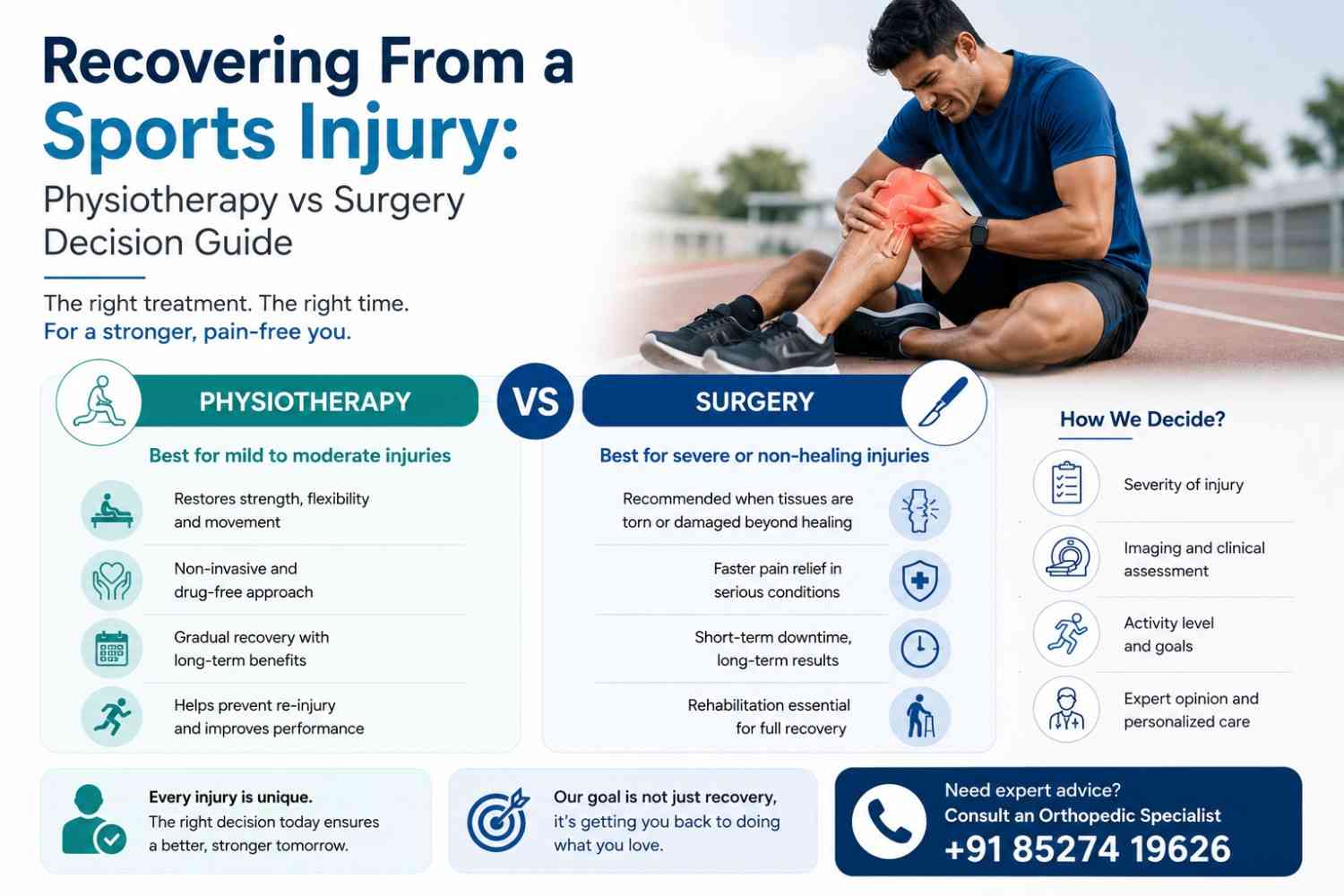
Recovering From a Sports Injury: Physiotherapy vs Surgery Decision Guide
One of the most common questions after a significant sports injury is whether surgery is genuinely necessary, or whether physiotherapy and conservative management will get the job done. The honest answer is that it depends heavily on the specific injury, its severity, and what matters most to the individual athlete, and understanding the actual decision-making framework helps make sense of a recommendation either way.
Injuries That Often Respond Well to Physiotherapy Alone
Grade 1 and 2 Ligament Sprains
Milder ligament injuries, where the ligament is stretched or partially torn but still providing meaningful joint stability, generally heal well with a structured physiotherapy programme focused on protecting the area initially, then progressively restoring strength and range of motion.
Muscle Strains
Most muscle strains, even moderately significant ones, respond well to a graduated rehabilitation programme without surgical intervention, since muscle tissue generally has good healing capacity when protected appropriately during the initial phase.
Partial Tendon Injuries Without Instability
Partial tears that don't significantly compromise joint stability or function often heal adequately with conservative treatment, particularly with a well-designed, progressive loading programme.
Injuries That More Often Need Surgery
Complete Ligament Tears Causing Instability
A fully torn ACL, for example, particularly in an athlete wanting to return to pivoting sports, often needs surgical reconstruction, since the torn ligament doesn't reliably heal on its own in a way that restores adequate joint stability for demanding athletic activity.
Complete Tendon Ruptures
A fully ruptured tendon, an Achilles tendon rupture is a common example, typically requires surgical repair to restore normal function, since the two torn ends generally don't heal back together adequately without surgical reattachment.
Displaced Fractures
Fractures involving significant displacement, particularly those affecting a joint surface, generally need surgical fixation to restore proper alignment and allow appropriate healing.
Injuries With Mechanical Blocking Symptoms
Injuries causing the joint to lock, catch, or give way, often related to loose cartilage fragments or significant meniscus tears, frequently need surgical treatment to address the underlying mechanical problem, since physiotherapy alone can't resolve a structural block.
Factors That Shape the Decision Beyond the Injury Itself
The Athlete's Goals and Sport
An athlete planning to return to competitive, high-demand pivoting sports has different stability requirements than someone whose primary goal is comfortable daily function, and this genuinely affects the surgical decision for certain borderline injuries.
Age and Activity Level
Younger, highly active patients and older, less active patients are sometimes reasonably managed differently for the same injury, based on functional demands and healing capacity.
Response to an Initial Trial of Conservative Treatment
For some injuries, a structured trial of physiotherapy first, with surgery reserved for cases where adequate improvement isn't achieved, is a reasonable and common approach rather than surgery being the immediate first step.
A Decision Made With Full Information, Not Assumption
The most useful approach is a clear conversation with your orthopedic surgeon about the specific injury, imaging findings, and how each option, physiotherapy first versus surgery, aligns with your specific goals and timeline, rather than assuming either surgery or conservative treatment based on general impressions about the injury type. Our sports injury treatment practice is built around exactly this individualised evaluation, since the right answer genuinely varies between two people with what looks like a similar injury on the surface. Our related articles on sports injuries in young athletes and rotator cuff injuries apply this same decision framework to two specific, commonly encountered injury types.
The Value of a Second Opinion for Borderline Cases
For injuries that genuinely sit in a grey area, where reasonable surgeons might disagree, a second opinion is a reasonable and normal step to take, not a sign of distrust in the first assessment. Sports medicine and orthopedic surgery involve genuine clinical judgment in borderline cases, and hearing a consistent recommendation from two independent evaluations, or understanding clearly why two opinions differ, gives most patients considerably more confidence in whichever path they ultimately choose.
Returning to Sport Safely, Whichever Path You Take
Regardless of whether treatment involves surgery or a conservative approach, return to sport should be guided by objective functional milestones, strength, range of motion, and sport-specific movement testing, rather than simply how much time has passed or how the athlete subjectively feels on a given day. Returning too early, a common pressure particularly around important competitions, meaningfully raises the risk of re-injury, sometimes a more serious one than the original.
Discuss Your Sports Injury Options
Frequently Asked Questions (FAQs)
1. Can a delayed decision between physiotherapy and surgery affect long-term outcomes?
For some injuries, yes, prolonged delay can occasionally make certain surgical repairs more technically challenging, which is one reason timely evaluation matters even when conservative treatment is the initial choice.
2. Does insurance coverage typically influence the treatment decision?
Practically speaking it can be a real consideration for some patients, though clinical appropriateness should remain the primary driver of the recommendation, with cost and coverage discussed openly alongside it.
3. Is it common for athletes to need a combination of both physiotherapy and surgery?
Yes, this is actually the norm rather than the exception for surgical cases, since physiotherapy before and after surgery is typically an essential part of achieving a good surgical outcome.
4. Can an athlete train other body parts while recovering from a specific injury?
Often yes, maintaining overall fitness and conditioning in unaffected areas during recovery is generally encouraged and can support a smoother return to full training once the injury has healed.
5. Can an athlete get a professional opinion on return-to-play readiness beyond just feeling ready?
Yes, objective functional testing, assessing strength, movement quality, and sport-specific tasks, provides a more reliable readiness assessment than subjective feeling alone.
6. Can a torn ACL heal without surgery?
The torn ligament itself doesn't reliably heal back together without surgery, though some patients, particularly less active ones or those willing to modify activity, manage functionally with physiotherapy and bracing alone.
7. How long does physiotherapy-based recovery typically take compared to surgery?
This varies considerably by injury, but conservative treatment can sometimes allow a faster initial return to activity, while surgical recovery, though sometimes longer initially, may provide more complete long-term stability for certain injuries.
8. Is it ever too late to have surgery after trying physiotherapy first?
For many injuries, no, surgery remains an option if conservative treatment doesn't provide adequate results, though this should be discussed with your surgeon based on the specific injury and time elapsed.
9. Can imaging alone determine whether surgery is needed?
Imaging provides important information, but the decision also depends on symptoms, functional demands, and the patient's goals, not imaging findings in isolation.
10. Do professional athletes always need surgery for significant injuries?
Not always, but the demands of competitive sport often push the decision toward surgery for injuries involving instability, since returning to elite-level performance typically requires the joint stability that surgical repair provides.
11. What happens if physiotherapy is tried first and doesn't work?
If conservative treatment doesn't provide adequate improvement after a reasonable trial period, surgery remains an option and can be pursued at that point without having lost significant ground.
This article is for educational purposes and does not replace personalized medical advice. Please consult a qualified physician before making changes to your treatment, medication, or health screening plan.
Related Articles
ACL Tear Without Surgery: Who May Benefit From Non-Surgical Treatment?
An ACL tear does not automatically mean surgery for every patient.
Knee Replacement Recovery Timeline: Walking, Stairs, and Return to Daily Activities
Knee-replacement recovery progresses gradually and varies by health, surgical plan, and rehabilitation.
Shoulder Pain at Night: Common Causes and When to See an Orthopedic Surgeon
Night shoulder pain can disrupt sleep and make everyday movement difficult.