6 min read
Spine Pain vs Slipped Disc: How to Tell the Difference
Back pain has many possible causes, and a slipped disc is only one of them. Here's how the two are actually distinguished, clinically.
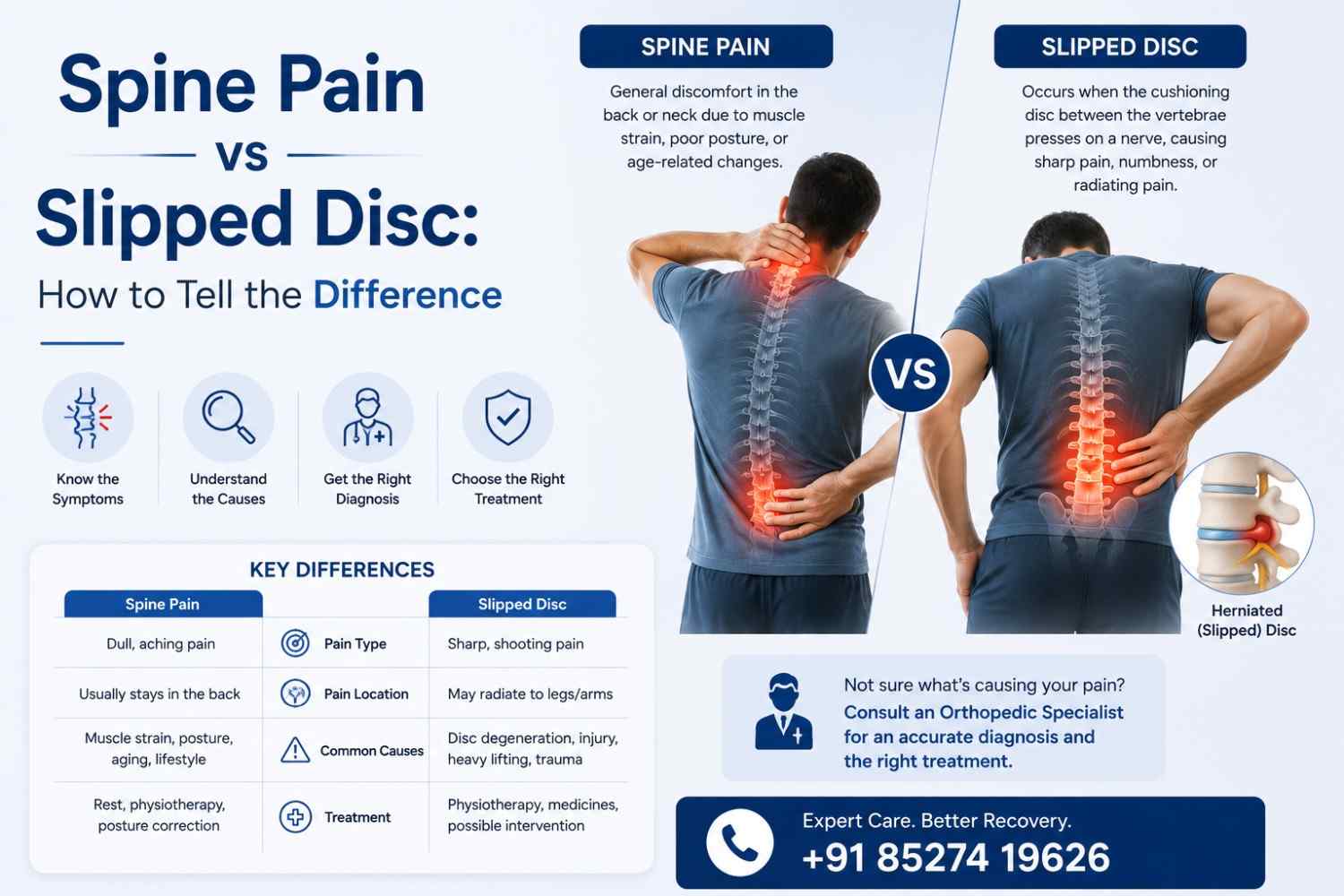
Spine Pain vs Slipped Disc: How to Tell the Difference
Back pain is extremely common, and "slipped disc" has become something of a catch-all term many people reach for whenever back pain occurs, whether or not a disc is actually involved. In reality, back pain has many possible causes, muscular strain, joint-related pain, and disc problems among them, and distinguishing between them clinically matters considerably for choosing the right treatment.
What a Slipped Disc Actually Is
The spine's vertebrae are cushioned by discs with a tougher outer layer and a softer, gel-like centre. A "slipped disc," more accurately called a herniated or prolapsed disc, occurs when this outer layer weakens or tears, allowing some of the inner material to bulge or protrude outward, sometimes pressing on a nearby nerve root. Our related article on slipped disc treatment covers this specific condition and its treatment in more depth.
Symptoms More Specific to a Slipped Disc
Pain radiating down the leg (sciatica), often described as sharp or burning, following a specific nerve pathway rather than staying localised to the back alone.
Numbness or tingling in a specific pattern down the leg or foot, corresponding to the affected nerve.
Weakness in specific muscle groups, sometimes noticed as difficulty lifting the foot (foot drop) or weakness when standing on toes or heels.
Pain that worsens with sitting, bending, or coughing, all of which increase pressure on the affected disc.
Symptoms More Typical of General Spine or Muscular Pain
Pain confined to the back without radiating down a leg in a specific nerve pattern.
Stiffness that's often worse with prolonged inactivity and improves somewhat with movement.
Pain related to a specific activity or posture, such as prolonged sitting at a desk or a recent unusual physical exertion.
No associated numbness, tingling, or weakness in the legs.
Why This Distinction Actually Matters
Muscular and general mechanical back pain typically responds well to rest, physiotherapy, activity modification, and time, usually improving within weeks. A genuine disc herniation with nerve involvement, while it also often improves with conservative treatment, sometimes requires a more targeted approach, and if symptoms are severe or progressive, particularly with significant weakness, may need more urgent evaluation and, in some cases, surgical intervention. Treating every episode of back pain identically, regardless of the underlying cause, risks both under-treating a genuine disc problem and over-treating what might simply be resolving muscular strain.
How the Diagnosis Is Actually Made
A thorough history and physical examination, including specific tests that assess nerve function and reproduce nerve-related pain patterns, often provides strong clinical clues. MRI, when needed, directly visualises disc structure and confirms whether a herniation is present and, if so, whether it's affecting a specific nerve root, providing the clearest picture for planning treatment.
Warning Signs That Need Prompt Evaluation
Certain symptoms warrant urgent attention regardless of the suspected cause: significant or progressively worsening leg weakness, loss of bladder or bowel control, or numbness in the groin or inner thigh area (saddle anesthesia), which can indicate a rare but serious condition called cauda equina syndrome requiring emergency surgical evaluation.
Getting an Accurate Diagnosis
Given how differently these conditions can present, and how differently they're best managed, a proper evaluation from an orthopedic spine specialist, rather than assuming based on symptoms alone, provides the clarity needed for effective treatment. Our spine treatment practice starts with exactly this kind of careful diagnostic process before recommending a specific treatment path, and our related article on slipped disc treatment covers what that treatment path typically involves once a herniation is confirmed.
Preventing Recurrence
Whatever the underlying cause of an episode of back pain, once symptoms settle, attention often shifts to reducing the risk of recurrence, since back pain, disc-related or otherwise, has a meaningful tendency to return without addressing contributing factors. Core and back-strengthening exercises, attention to lifting technique, particularly avoiding lifting with a rounded rather than neutral spine, and addressing prolonged poor sitting posture all play a genuine role in reducing future episodes, and are typically incorporated into physiotherapy regardless of which specific condition was originally diagnosed.
The Role of Imaging Findings in Context
It's worth knowing that disc bulges and even some degree of disc degeneration show up on MRI scans of many people without any back pain at all, which means an imaging finding needs to be interpreted alongside the clinical picture, not treated as an automatic explanation for symptoms in isolation. This is exactly why a thorough clinical examination matters as much as, or more than, the imaging report alone, and why treatment decisions shouldn't be made purely from a scan without correlating it to the patient's actual symptoms and examination findings.
Frequently Asked Questions (FAQs)
1. Can a slipped disc cause pain only on one side of the body?
Yes, this is actually the more typical pattern, since a herniation usually affects a nerve root on one specific side rather than both symmetrically.
2. Can regular exercise help prevent future episodes of disc-related back pain?
Yes, core strengthening and general fitness are associated with reduced risk of recurrent disc problems, making it a worthwhile long-term investment beyond the acute treatment phase.
3. Is an MRI always necessary to diagnose a slipped disc?
Not always immediately, many cases are initially managed based on clinical examination alone, with MRI reserved for persistent symptoms, significant neurological findings, or when surgery is being considered.
4. Can stress or anxiety worsen back pain?
Yes, psychological stress can genuinely amplify the perception of pain and contribute to muscle tension, which is part of why a holistic approach to back pain management is often more effective than focusing on the physical findings alone.
5. Does all back pain mean I have a slipped disc?
No, back pain has many possible causes, and disc herniation is just one of them. A proper evaluation is needed to determine the actual cause rather than assuming based on pain alone.
6. Can a slipped disc heal without surgery?
Yes, many disc herniations improve significantly with conservative treatment including physiotherapy, activity modification, and time, with surgery reserved for cases with severe or progressive symptoms.
7. What does sciatica actually mean?
Sciatica describes pain radiating along the sciatic nerve pathway, typically from the lower back down the back of the leg, often caused by nerve compression from a disc herniation, though not always.
8. Is bed rest recommended for a slipped disc?
Prolonged bed rest is generally not recommended, as it can actually worsen outcomes. Guided, appropriate activity and physiotherapy typically produce better results than extended inactivity.
9. When is surgery necessary for a slipped disc?
Surgery is generally considered when conservative treatment hasn't provided adequate relief after a reasonable trial period, or urgently if there's significant progressive weakness or the warning signs described above.
10. Can poor posture at a desk job cause a slipped disc?
Prolonged poor posture and sitting can contribute to spine stress and may be a factor in some cases, though disc herniation typically involves multiple contributing factors rather than posture alone.
This article is for educational purposes and does not replace personalized medical advice. Please consult a qualified physician before making changes to your treatment, medication, or health screening plan.
Related Articles
Knee Replacement के बाद क्लिक: क्या करें?
Knee replacement के बाद क्लिक की आवाज कब सामान्य हो सकती है? दर्द, सूजन या अस्थिरता के साथ आवाज आने पर डॉक्टर से कब मिलें, जानें।
ACL Graft Options: Hamstring vs Patellar vs Quad
ACL reconstruction can use different graft sources. Learn how hamstring, patellar tendon and quadriceps tendon grafts differ, what surgeons consider, and why selection depends on the knee and patient goals.
Knee Replacement Infection: Early Warning Signs and When to Contact Your Surgeon
Learn the early and late warning signs of infection after knee replacement, when to contact the surgical team, and why prompt assessment matters.